The Rogers-Selberg identities are a set of three analytic q-series identities of Rogers-Ramanujan-type
appearing as equations 33, 32, and 31 in Slater (1952). For , they are
Andrews (1980) gave a technique for combinatorially interpreting the Rogers-Selberg identities.
The identities were discovered by Rogers (1894, 1917) and independently rediscovered by Selberg (1936) and Dyson (1943). They were subsequently generalized by Bailey (1947) before appearing in Slater's list of 130 identities of the Rogers-Ramanujan type (Slater 1952).
Andrews, G. E. "Gap-Frequency Partitions and the Rogers-Selberg Identities." Ars. Combin.9, 201-210, 1980.Bailey,
W. N. "Some Identities in Combinatory Analysis." Proc. London Math.
Soc.49, 421-435, 1947. https://doi.org/10.1112/plms/s2-49.6.421.Dyson,
F. J. "Three Identities in Combinatory Analysis." J. London Math.
Soc.18, 35-39, 1943.Gasper, G. and Rahman, M. Basic
Hypergeometric Series. Cambridge, England: Cambridge University Press, pp. 36-37,
1990.Hahn, H. "Septic Analogues of the Rogers-Ramanujan Functions."
Acta Arith.110, 381-399, 2003.Mc Laughlin, J.; Sills,
A. V.; and Zimmer, P. "Rogers-Ramanujan-Slater Type Identities." Elec.
J. Combin., Dynamic Survey DS15, Dec. 15, 2022. https://doi.org/10.37236/36.Milne,
S. C. "Classical Partition Functions and the Rogers-Selberg Identity." Disc. Math.99,
199-246, 1992.Rogers, L. J. "Second Memoir on the Expansion
of Certain Infinite Products." Proc. London Math. Soc.25, 318-343,
1894. https://doi.org/10.1112/plms/s1-25.1.318.Rogers,
L. J. "On Two Theorems of Combinatory Analysis and Some Allied Identities."
Proc. London Math. Soc.16, 315-336, 1917.Selberg, A.
"Über einige arithmetische Identitäten." Avh. Norske Vid.-Akad.
Oslo I, No. 8, 1-23, 1936.Slater, L. J. "Further
Identities of the Rogers-Ramanujan Type." Proc. London Math. Soc. Ser. 254,
147-167, 1952.Sloane, N. J. A. Sequences A104408,
A104409, and A104410
in "The On-Line Encyclopedia of Integer Sequences."


 , they are


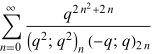


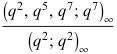


 uses the q-Pochhammer symbol.

 Rogers-Selberg Identity." Disc. Math. 99,
199-246, 1992.Rogers, L. J. "Second Memoir on the Expansion
of Certain Infinite Products." Proc. London Math. Soc. 25, 318-343,
1894.