


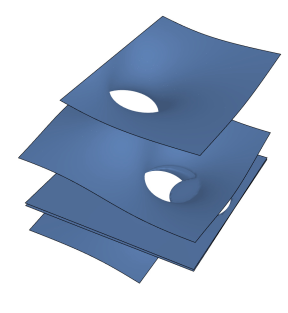
The Riemann minimal examples are a one-parameter family of properly embedded singly periodic minimal surfaces of genus 0 in three-dimensional Euclidean space. They have infinitely many planar ends. Each horizontal plane intersects a member in a circle or a straight line. A translational quotient has genus 1 and two planar ends (Meeks and Pérez 2012, p. 28). A finite portion of a member of the family is illustrated above.
Geometrically, each surface resembles an infinite stack of parallel planes connected by necks. The catenoid and helicoid occur as limits of the family under suitable normalizations (Meeks et al. 2015). Together with the plane, catenoid, and helicoid, the Riemann minimal examples exhaust the connected, properly embedded minimal surfaces without boundary and of genus 0 in three-dimensional Euclidean space (Meeks et al. 2015).
