

A resistance-regular graph is a finite connected simple graph for which  is independent of the graph
vertex
 , where
 is resistance distance
with each graph edge a unit resistor (Zhou et al.
2016). Equivalently, the Moore-Penrose
matrix inverse
 of its Laplacian matrix
has constant diagonal. Every connected walk-regular
graph, and hence every connected vertex-transitive
graph, is resistance-regular. Resistance-regularity also means that each vertex
has expected degree
 in a uniformly chosen spanning
tree.
Khan and Haidar (2026) show that resistance-regular graphs need not be regular graphs. For every even  ,
they construct a graph
 on
 vertices, half of degree
 and half of degree
 ,
with common diagonal entry
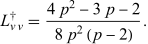 |
For  , there are 16 vertices and 52 edges, and
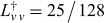 . To construct
 , take disjoint
 -vertex cliques
 and sets
 .
Completely join
 to
 .
For each
 , make the
 vertices
 into a cocktail
party graph by omitting just the matching pairs
 ; add no other edges. The authors' computer-assisted
enumeration excludes nonregular resistance-regular graphs on at most 12 vertices,
leaving the minimum order between 13 and 16. The enumeration uses floating-point
filters with stated backward-error bounds, followed by exact checks.
Any nonregular resistance-regular graph has minimum degree at least 3 and connected graph complement; if bipartite, its two vertex
parts have equal size. If  has at most two distinct nonzero eigenvalues, resistance-regularity
forces walk-regularity. With three distinct nonzero eigenvalues, at most two vertex
degrees occur; nonregular examples with four such eigenvalues exist, while the
three-eigenvalue case remains open (Khan and Haidar 2026).
For every integer  ,
Khan and Haidar (2026) construct a resistance-regular graph on
 vertices whose degrees are
 and
 .
It is the blow-up of a six-cycle with opposite vertices replaced by independent
sets of size
 and the other four by cliques of size
 , with complete joins between consecutive parts. They
also give examples with exactly three and exactly four distinct degrees. For every
resistance-regular graph, the maximum and minimum degrees satisfy
 , improved to
 when exactly two degrees occur. With algebraic
connectivity
 ,
they additionally satisfy
 .
If the full resistance rows are equal as multisets, the stronger restriction
 holds; whether such a graph must be regular remains open. The authors report that
Claude assisted with the computational search scripts.
