


Resistance-equivalent graphs are nonisomorphic simple graphs with equal resistance spectra, the multisets of resistance distances between unordered pairs of distinct vertices when each edge has unit resistance. For disconnected graphs, the resistance distance between vertices in different connected components is taken to be infinity.
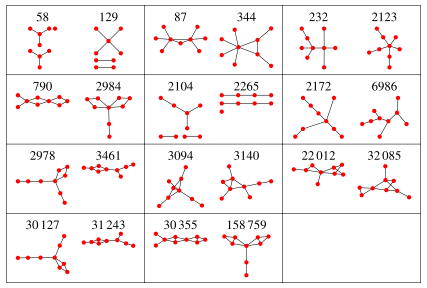
All nonisomorphic simple graphs on eight or fewer vertices are determined by their resistance spectra. However, exactly 11 pairs of nonisomorphic graphs with nine vertices are resistance-equivalent, illustrated above (in the illustration, the numbers indicate the graph numbers in McKay's enumeration of 9-vertex graphs), where the second and third of these pairs were found by Baxter (1999b).
The numbers of simple graphs determined by their resistance spectra on  vertices for
 , 2, ... are therefore given by 1, 2, 4, 11, 34, 156, 1044,
12346, 274646, 12005070, ... (OEIS A178944),
and the numbers of graphs not determined by resistance are 0, 0, 0, 0, 0, 0, 0, 0,
22, 98, ... (OEIS A178999).
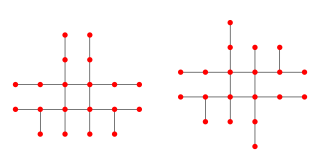
Rickard (1999a) found the pair of 20-vertex resistance-equivalent graphs illustrated above.
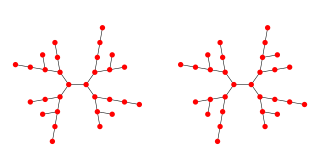
Baxter (1999b) subsequently conjectured that no nonisomorphic biconnected graphs were resistance-equivalent, a conjecture that was nearly immediately refuted by Rickard (1999b) with the pair of 60-vertex biconnected graphs obtained as the doubles of the graphs illustrated above.
All pairs of resistance-equivalent graphs listed above (for which the chromatic polynomial can be computed in reasonable time) are also chromatically equivalent graphs.
