

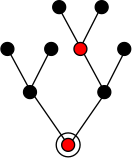
A red-black tree is a rooted extended binary tree satisfying the following conditions:
1. Every internal node has two children, each colored either red or black.
2. Every tree leaf node is colored black.
3. Every red node has both of its children colored black.
4. Every graph path from the root vertex to a tree leaf contains the same number (the "black-height") of black nodes.
The root vertex may be red or black, and left and right children are distinguished.
Let  be the number of internal nodes of a red-black tree.
Then the number of red-black trees for
 , 2, ... is 2, 2, 3, 8, 14, 20, 35, 64, 122, ... (OEIS A001131). The number of trees
with black root vertices and red root
vertices are given by OEIS A001137 and
OEIS A001138, respectively. A red-black tree
with
 internal nodes has
 tree leaves.
Let  be the generating function for the number
of red-black trees of black-height
 indexed by the number of tree leaves.
Then
 |
(1)
|
where  .
If
 is the generating
function for the number of red-black trees, then
 |
(2)
|
(Ruskey). Let  be the number of red-black trees with
 tree leaves,
 the number of red-rooted trees,
and
 the number of black-rooted trees. For
 , all three quantities satisfy the recurrence
relation
 |
(3)
|
where  is a binomial coefficient,
 ,
 for
 ,
 ,
 for
 , and
 for
 (Ruskey).

 -Trees: Data Structures and Maintenance Algorithms." Acta
Informat. 1, 290-306, 1972.Binstock, A. and Rex, J.