

The radiality centrality of a graph vertex is a distance-based centrality measure that compares the distance from that vertex to other vertices
with the graph diameter. For a connected graph
 on
on  vertices with diameter
  ,
,
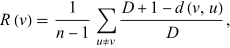 |
where  denotes graph distance.
Radiality was introduced for measuring the extent of an individual's connectedness and reachability in a network (Valente and Foreman 1998). It is used in social network analysis for vertices whose usefulness depends on reaching many others without being far from them. It is related to closeness centrality, since both are based on graph distances from a vertex to other vertices, but radiality compares those distances with the graph's maximum distance scale.
Radiality centrality is implemented in the Wolfram Language as RadialityCentrality[g], and precomputed values for many named graphs can be obtained using GraphData[graph, "RadialityCentralities"].
