

The closeness centrality of a graph vertex  in a graph is the reciprocal of
the average graph distance from
in a graph is the reciprocal of
the average graph distance from  to the other vertices reachable from
  . For a connected graph
  on
on  vertices,
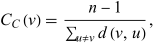 |
where  denotes graph distance. Since
  , the denominator is the vertex
transmission
, the denominator is the vertex
transmission  .
.
In applications to social, communication, transportation, and biological networks, vertices with high closeness centrality are those from which the rest of the network can be reached using relatively short paths (Freeman 1978). It is used when fast access, dissemination, or response from a single vertex to the rest of a network is important. Like betweenness centrality, closeness centrality is a global centrality measure, but it measures nearness from a vertex to other vertices rather than how often the vertex mediates shortest paths between other pairs.
Closeness centrality is implemented in the Wolfram Language as ClosenessCentrality[g], and precomputed values for many named graphs can be obtained using GraphData[graph, "ClosenessCentralities"].
