


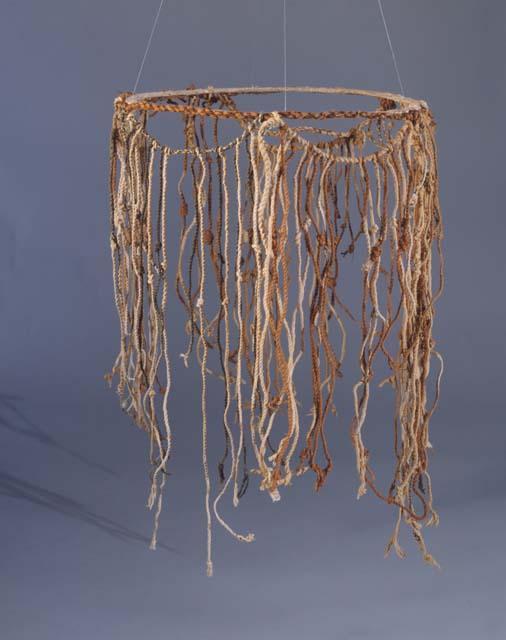
A quipu, also spelled khipu or quipo, is an Andean recording device made from pendant cords attached to a main cord. The surviving example shown above is held by the Peabody Museum of Archaeology and Ethnology at Harvard University.
Many surviving numerical quipus encode integers in decimal place-value notation: successive knot clusters represent units, tens, hundreds, and higher powers of 10, with the higher places nearer the main cord (Locke 1912, Ascher and Ascher 1997).
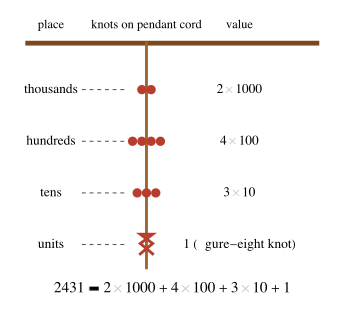
In the units position, a long knot with two through nine turns records the corresponding digit, while a figure-eight knot records 1. In the higher positions, groups of simple knots record digits 1 through 9. The absence of a knot in a place records 0. Some quipus include separate total cords, making their arithmetical organization directly visible. Quipus also carry information through cord color, fiber, direction, and attachment, but the interpretation of such nonnumerical features remains incomplete.
