


Following the vertex-and-edge-transitive convention, a quintic symmetric graph is a quintic graph (i.e., regular
of degree 5) that is both vertex-transitive
and edge-transitive. Since quintic
graphs exist only on an even number of nodes,
so do symmetric quintic graphs. The only symmetric quintic graph on 9 or fewer nodes is the complete
graph  .
The census of Conder (2021) contains all 11 connected quintic symmetric graphs on at most 46 vertices.
The following table gives the numbers of nonisomorphic
quintic symmetric graphs on  vertices for
 , 2, ..., with separate counts for the connected
and disconnected subclasses.
| graphs | OEIS | counts |
| all | A401568 | 0, 0, 1, 0, 1, 3, 0, 1, 1, 1, 1, 4, 0, 0, 2, 3, 0, 4, 0, 1, 2, 1, 0, ... |
| connected | A400580 | 0, 0, 1, 0, 1, 2, 0, 1, 0, 0, 1, 1, 0, 0, 0, 2, 0, 1, 0, 0, 1, 0, 0, ... |
| disconnected | A401569 | 0, 0, 0, 0, 0, 1, 0, 0, 1, 1, 0, 3, 0, 0, 2, 1, 0, 3, 0, 1, 1, 1, 0, ... |
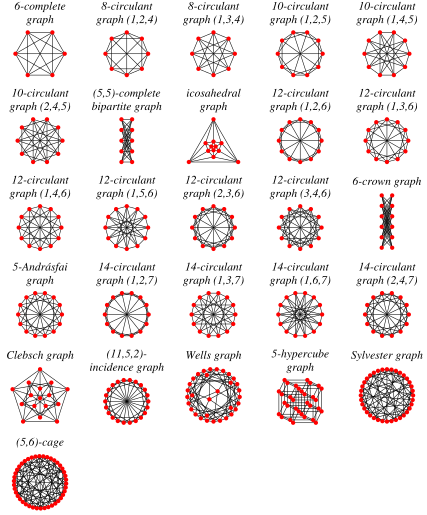
Some quintic symmetric graphs are illustrated above. The following table gives a selection of notable examples, where  denotes a perfect matching.
| graph | nodes |
complete graph  | 6 |
complete bipartite graph  | 10 |
| icosahedral graph | 12 |
crown graph  | 12 |
| Clebsch graph | 16 |
 -difference set incidence
graph | 22 |
 -bipartite (0,2)-graph | 24 |
| Wells graph | 32 |
hypercube
graph  | 32 |
| Sylvester graph | 36 |
generalized
hexagon  | 42 |
incidence graph of affine
plane  minus a parallel class | 50 |
odd graph  | 126 |
generalized octagon  | 170 |
| 4-middle layer graph | 252 |
permutation star graph  | 720 |
