


Quasiaddition, also called quasicrystal addition, is a binary operation on points in a vector
space over  defined by
 |
(1)
|
where  is the golden ratio (Berman and Moody 1994). It is
generally neither commutative nor associative,
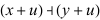
but satisfies identities such as
is the golden ratio (Berman and Moody 1994). It is
generally neither commutative nor associative,
but satisfies identities such as
 |  |  |
(2)
|
 |  |  |
(3)
|
 |  |  |
(4)
|
(Berman and Moody 1994).
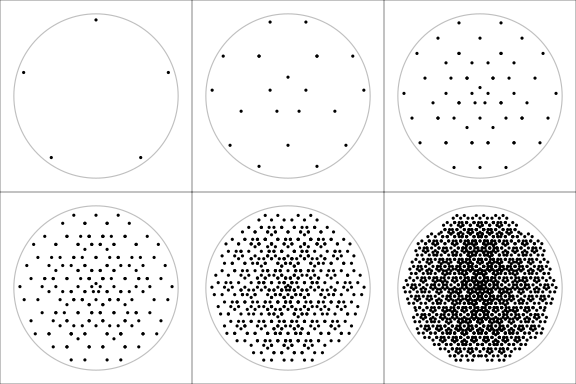
Starting with a set  of the five vertices of a regular
pentagon, define
of the five vertices of a regular
pentagon, define 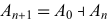 . The initial set
  together with the first five iterates give the point
set patterns illustrated above (Berman and Moody 1994).
together with the first five iterates give the point
set patterns illustrated above (Berman and Moody 1994).
Quasiaddition is useful in the algebraic theory of aperiodic tilings and quasicrystals with five-fold symmetry (Moody and Patera 1993, Berman
and Moody 1994). In a cut-and-project construction, a projected point  is retained precisely when its Galois
conjugate
is retained precisely when its Galois
conjugate  lies in a fixed region called the window. For five-fold constructions, conjugation
sends
lies in a fixed region called the window. For five-fold constructions, conjugation
sends  to
to  ,
so
,
so
 |
(5)
|
where the coefficients are nonnegative and sum to 1. If the window is convex, this makes  a convex combination of
  and
and  , so the point set is closed
under quasiaddition (Berman and Moody 1994).
, so the point set is closed
under quasiaddition (Berman and Moody 1994).
