Here
is a free variable, and the quantifier-free
condition describes precisely the values of for which the original formula
holds. When there are no free variables, elimination
instead determines the truth value of a sentence (Basu
2017, p. 109).
General real quantifier elimination has doubly exponential worst-case complexity, with examples requiring doubly exponential output size (Davenport and Heintz 1988,
Caviness and Johnson 1998). The number of quantifier
alternations matters. For a fixed number of blocks, algorithms with singly exponential
dependence on the number of variables are available
(Basu 2017).
Anai, H. "Quantifier Elimination in Control Theory--Real Quantifier Elimination in Practice." Josai Math. Monogr.2, 105-137,
2000. https://libir.josai.ac.jp/il/user_contents/02/G0000284repository/pdf/JOS-KJ00000229285.pdf.Basu,
S. "Algorithms in Real Algebraic Geometry: A Survey." In Real Algebraic
Geometry (Ed. K. Bekka, G. Fichou, J.-P. Monnier, and R. Quarez).
Paris, France: Soc. Math. France, pp. 107-153, 2017. https://smf.emath.fr/node/44883.
https://www.math.purdue.edu/~sbasu/raag_survey2011_final-sep4-2014.pdf.Caviness,
B. F. and Johnson, J. R. (Ed.). Quantifier
Elimination and Cylindrical Algebraic Decomposition. Vienna, Austria: Springer-Verlag,
1998. https://doi.org/10.1007/978-3-7091-9459-1.Collins,
G. E. "Quantifier Elimination for Real Closed Fields by Cylindrical Algebraic
Decomposition." In Automata Theory and Formal Languages: 2nd GI Conference,
Kaiserslautern, May 20-23, 1975 (Ed. H. Brakhage). Berlin, Germany: Springer-Verlag,
pp. 134-183, 1975. https://doi.org/10.1007/3-540-07407-4_17.Collins,
G. E. "Quantifier Elimination by Cylindrical Algebraic Decomposition--Twenty
Years of Progress." In Quantifier
Elimination and Cylindrical Algebraic Decomposition (Ed. B. F. Caviness
and J. R. Johnson). New York: Springer-Verlag, pp. 8-23, 1998.Collins,
G. E. and Hong, H. "Partial Cylindrical Algebraic Decomposition for Quantifier
Elimination." J. Symb. Comput.12, 299-328, 1991.Dantzig,
G. B. and Eaves, B. C. "Fourier-Motzkin Elimination and Its Dual."
J. Combin. Theory Ser. A14, 288-297, 1973. https://doi.org/10.1016/0097-3165(73)90004-6.Davenport,
J. H. "Computer Algebra for Cylindrical Algebraic Decomposition."
Report TRITA-NA-8511, NADA, KTH, Stockholm, Sept. 1985.Davenport,
J. and Heintz, J. "Real Quantifier Elimination Is Doubly Exponential."
J. Symb. Comput.5, 29-35, 1988.Dolzmann, A. "Solving
Geometric Problems with Real Quantifier Elimination." In Automated Deduction
in Geometry (Ed. X.-S. Gao, D. Wang, and L. Yang). Berlin, Germany:
Springer-Verlag, pp. 14-29, 1999. https://doi.org/10.1007/3-540-47997-X_2.Dolzmann,
A. and Sturm, T. "Simplification of Quantifier-Free Formulae over Ordered Fields."
J. Symb. Comput.24, 209-231, 1997.Dolzmann, A.; Sturm,
T.; and Weispfenning, V. "Real Quantifier Elimination in Practice." In
Algorithmic Algebra and Number Theory (Ed. B. H. Matzat, G.-M. Greuel,
and G. Hiss). Berlin, Germany: Springer-Verlag, pp. 221-247, 1999. https://doi.org/10.1007/978-3-642-59932-3_11.Dolzmann,
A. and Weispfenning, V. "Local Quantifier Elimination." http://www.fmi.uni-passau.de/~dolzmann/refs/MIP-0003.ps.Z.Hales,
T. C. "Some Algorithms Arising in the Proof of the Kepler Conjecture."
In Discrete and Computational Geometry: The Goodman-Pollack Festschrift (Ed.
B. Aronov, S. Basu, J. Pach, and M. Sharir). Berlin, Germany:
Springer-Verlag, pp. 489-507, 2003. https://doi.org/10.1007/978-3-642-55566-4_22.Hales,
T. C. "Can -Adic Integrals Be Computed?" In Contributions to Automorphic
Forms, Geometry, and Number Theory: A Volume in Honor of Joseph Shalika (Ed.
H. Hida, D. Ramakrishnan, and F. Shahidi). Baltimore, MD: Johns Hopkins
University Press, pp. 313-329, 2004. https://arxiv.org/abs/math/0205207.Harrison,
J. Theorem
Proving with the Real Numbers. London: Springer-Verlag, 1998. https://doi.org/10.1007/978-1-4471-1591-5.Heintz,
J.; Roy, R.-F.; and Solerno, P. "Complexité du principe de Tarski-Seidenberg."
C. R. Acad. Sci. Paris309, 825-830, 1989.Hong, H.;
Liska, R.; and Steinberg, S. "Testing Stability by Quantifier Elimination."
J. Symb. Comput.24, 161-187, 1997. https://doi.org/10.1006/jsco.1997.0121.Lazard,
D. "Quantifier Elimination: Optimal Solution for Two Classical Examples."
J. Symb. Comput.5, 261-266, 1988. https://doi.org/10.1016/S0747-7171(88)80015-4.Liska,
R. and Steinberg, S. "Applying Quantifier Elimination to Stability Analysis
of Difference Schemes." Comput. J.36, 497-503, 1993. https://doi.org/10.1093/comjnl/36.5.497.Loos,
R. and Weispfenning, V. "Applying Lattice Quantifier Elimination." Comput.
J.36, 450-461, 1993.Matiyasevich, Y. Hilbert's
Tenth Problem. Cambridge, MA: MIT Press, 1993. https://logic.pdmi.ras.ru/~yumat/H10Pbook/.Matiyasevich,
Y. "Elimination of Quantifiers from Arithmetical Formulas Defining Recursively
Enumerable Sets." Math. Comput. Simul.67, 125-133, 2004. https://doi.org/10.1016/j.matcom.2004.05.013.Munro,
N. (Ed.). Symbolic
Methods in Control System Analysis and Design. London: Institution of Electrical
Engineers, 1999. https://doi.org/10.1049/PBCE056E.Sawada,
H. and Yan, X.-T. "Application of Gröbner Bases and Quantifier Elimination
for Insightful Engineering Design." Math. Comput. Simul.67, 135-148,
2004. https://doi.org/10.1016/j.matcom.2004.05.014.Strzebonski,
A. "Solving Algebraic Inequalities." Mathematica J.7, 525-541,
2000.Sturm, T. and Weispfenning, V. "Computational Geometry Problems
in REDLOG." In Automated Deduction in Geometry (Ed. D. Wang). Berlin,
Germany: Springer-Verlag, pp. 58-86, 1998. https://doi.org/10.1007/BFb0022720.Trott,
M. "Polynomials in Inequalities." §1.2.3 in The
Mathematica GuideBook for Symbolics. New York: Springer-Verlag, 2006. https://doi.org/10.1007/0-387-28815-5.
https://www.mathematicaguidebooks.org/.Weispfenning,
V. "Semilinear Motion Planning in REDLOG." Appl. Algebra Eng. Commun.
Comput.12, 455-475, 2001. https://doi.org/10.1007/s002000100086.Weispfenning,
V. "The Complexity of Linear Problems in Fields." J. Symb. Comput.5,
3-27, 1988.


 and existential
quantifier
 )
from a quantified system. A first-order
theory allows quantifier elimination if, for each quantified formula,
there exists an equivalent quantifier-free formula. Examples
of such theories include the real numbers with
 ,
 ,
 , and
 , and the complex numbers
with
 ,
 ,
and
 .
For example, over the real numbers,

 is a free variable, and the quantifier-free
condition describes precisely the values of
 for which the original formula
holds. When there are no free variables, elimination
instead determines the truth value of a sentence (Basu
2017, p. 109).

 is a free variable, and the equivalence follows
from the strict monotonicity of
 . An example with a universal
quantifier is

 ,
 ,
and
 are real and
 and
 are free variables. This
equivalence follows by completing the square.
 holds for every
 . For integer variables
with addition and multiplication,
there is no general algorithm for quantifier elimination.
Such a procedure would decide whether an arbitrary polynomial
in several variables with integer coefficients vanishes at a point
with all coordinates in the integers,
contrary to the negative solution of Hilbert's
tenth problem (Matiyasevich 1993, 2004). Individual integer
statements may still be easy to decide. For example, the assertion that
 has integer solutions
 and
 for every positive integer
 is false at
 , whereas the assertion with real
 and
 is true.
 , and an open disk of radius
1 with center
 , where
 (Trott 2006). The horizontal coordinates
of their centers agree, so their interiors
intersect iff

 shows that an intersection occurs at some real time
iff
 . At
 , the two boundaries touch
at
 ,
while the interiors remain disjoint.
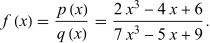
 , the assertion
 can be written as

 is positive for
 , so clearing it preserves the inequalities.
The resulting formula contains only polynomials
and inequalities. Eliminating
 ,
 , and
 gives

 is the unknown limit rather than
a variable to eliminate (Trott 2006).

 -Adic Integrals Be Computed?" In Contributions to Automorphic
Forms, Geometry, and Number Theory: A Volume in Honor of Joseph Shalika (Ed.
H. Hida, D. Ramakrishnan, and F. Shahidi). Baltimore, MD: Johns Hopkins
University Press, pp. 313-329, 2004.