TOPICS
Search

Pseudometric


A pseudometric on a set X is a nonnegative function g:X×X->R satisfying g(x,x)=0, symmetry g(x,y)=g(y,x), and the triangle inequality g(x,z)<=g(x,y)+g(y,z) for all x,y,z in X (Knapp 2016, p. 84). Unlike a metric, it allows the distance between two distinct points to be zero.

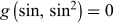
An example of a pseudometric on the set of all functions phi:R->R is defined by g(phi,psi)=|phi(0)-psi(0)|. It is nonnegative, symmetric, fulfills the triangle inequality and the condition g(phi,phi)=0, but it is also true that g(sin,sin^2)=0.

A pseudometric determines an equivalence relation by x∼y iff g(x,y)=0. On the set X/∼ of equivalence classes, the formula

 g^_([x],[y])=g(x,y)

defines a metric. The triangle inequality ensures that this value does not depend on the representatives chosen for [x] and [y]. Thus identifying points at zero distance gives a metric space (Knapp 2016, p. 95).


See also

Metric, Pseudometric Topology, Quotient Space

Portions of this entry contributed by Margherita Barile

Explore with Wolfram|Alpha

References

Kelley, J. L. General Topology. New York: Van Nostrand, 1955.Knapp, A. W. Basic Real Analysis, Digital 2nd ed. East Setauket, NY: Author, pp. 84 and 95, 2016. https://www.math.stonybrook.edu/~aknapp/download/b2-realanal-inside.pdf.

Referenced on Wolfram|Alpha

Pseudometric

Cite this as:

Weisstein, Eric W., with contributions by Margherita Barile. "Pseudometric." From MathWorld--A Wolfram Resource. https://mathworld.wolfram.com/Pseudometric.html

Subject classifications