

The proper generalized decomposition (PGD) is a numerical method for approximating a multivariate function by a separated representation.
For a function  , the representation has the form
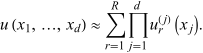 |
Each summand is a rank-one tensor, and the approximation is enriched by computing additional products until a prescribed accuracy is reached. The one-variable factors in a new product are commonly determined successively while the other factors are held fixed (Chinesta et al. 2011).
The construction can be viewed as a numerical extension of separation of variables. Since it stores and computes with one-variable factors instead
of a full grid in  , it is particularly useful for high-dimensional
partial differential equations. Unlike
the proper orthogonal decomposition,
which normally extracts a reduced basis from already computed snapshots, PGD constructs
a separated approximation while solving the governing problem.
, it is particularly useful for high-dimensional
partial differential equations. Unlike
the proper orthogonal decomposition,
which normally extracts a reduced basis from already computed snapshots, PGD constructs
a separated approximation while solving the governing problem.
