

A tensor decomposition expresses a tensor as a combination of simpler tensors. For a multidimensional array  , the CANDECOMP/PARAFAC
decomposition, also called the canonical polyadic (CP) decomposition, has the
form
, the CANDECOMP/PARAFAC
decomposition, also called the canonical polyadic (CP) decomposition, has the
form
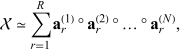 |
where  denotes the tensor direct product. Each summand
is an
denotes the tensor direct product. Each summand
is an  -fold
tensor direct product of vectors
and has tensor decomposition rank one;
an exact decomposition uses equality in place of approximation. The minimum number
of summands in an exact CP decomposition is the tensor
decomposition rank. For a symmetric tensor,
a decomposition using repeated factors defines symmetric
tensor rank. The Comon conjecture asserted
equality of these two ranks.
-fold
tensor direct product of vectors
and has tensor decomposition rank one;
an exact decomposition uses equality in place of approximation. The minimum number
of summands in an exact CP decomposition is the tensor
decomposition rank. For a symmetric tensor,
a decomposition using repeated factors defines symmetric
tensor rank. The Comon conjecture asserted
equality of these two ranks.
The Tucker decomposition represents the tensor by a smaller core tensor  and one factor matrix
for each mode,
and one factor matrix
for each mode,
 |
where  denotes multiplication along the
  th index. CP and Tucker decompositions generalize aspects of
the matrix singular value decomposition;
the Tucker decomposition is also a higher-dimensional
analog of principal component analysis.
Tensor decompositions are used for compression, dimensionality
reduction, and the analysis of multiway data.
th index. CP and Tucker decompositions generalize aspects of
the matrix singular value decomposition;
the Tucker decomposition is also a higher-dimensional
analog of principal component analysis.
Tensor decompositions are used for compression, dimensionality
reduction, and the analysis of multiway data.
