

The principle of virtual work characterizes equilibrium by the vanishing of the work of applied forces under every infinitesimal displacement compatible with bilateral constraints at a fixed time. For ideal constraints, whose reaction forces do no virtual work, it takes the form
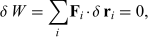 |
where the dot product pairs each applied force  with a permissible displacement
 (Goldstein 1980).
Writing the positions in independent coordinates  , define the generalized forces by
 . Then
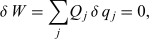 |
so equilibrium requires  for each independent coordinate. For conservative forces
with scalar potential
 , the relation
 makes equilibrium a stationarity condition on
 .
It is not necessarily a minimum; stability requires additional conditions. This connects
the principle with the calculus of variations
and the use of a Lagrangian function in mechanics.
