

The  -state Potts model on a finite
graph
-state Potts model on a finite
graph  assigns to each graph vertex
  a state
  . For a positive
integer
. For a positive
integer  and real interaction parameter
  , set
, set  . The zero-field partition
function can then be written
. The zero-field partition
function can then be written
 |
(1)
|
where  is the Kronecker
delta. Equal states on adjacent graph vertices
are favored when
is the Kronecker
delta. Equal states on adjacent graph vertices
are favored when  and disfavored when
  .
Potts (1952) introduced the model as a
.
Potts (1952) introduced the model as a  -state generalization of the Ising
model, which is recovered at
-state generalization of the Ising
model, which is recovered at  up to a constant normalization
and a rescaling of
up to a constant normalization
and a rescaling of  .
.
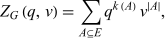
Expanding the product and then summing over the states gives the Fortuin-Kasteleyn or random-cluster model representation
 |
(2)
|
where  is the number of connected components of the
spanning subgraph
is the number of connected components of the
spanning subgraph  (Fortuin and Kasteleyn 1972). Indeed, after the graph
edges in
(Fortuin and Kasteleyn 1972). Indeed, after the graph
edges in  have imposed equality of incident states, each connected
component may be assigned any one of the
have imposed equality of incident states, each connected
component may be assigned any one of the  states. The right side is a polynomial
in
states. The right side is a polynomial
in  and
and  , so it extends the partition
function from positive integers
, so it extends the partition
function from positive integers  to arbitrary complex numbers
  and
and  .
.
For the homogeneous random-cluster model in which every graph edge has parameter  , the corresponding normalizing sum is
 |
(3)
|
Thus  gives independent bond percolation, while other positive
values of
gives independent bond percolation, while other positive
values of  weight a configuration of graph edges according to
its number of connected components.
weight a configuration of graph edges according to
its number of connected components.
Setting  and
and  , the same expansion identifies the
Potts partition function
with an evaluation of the Tutte polynomial:
, the same expansion identifies the
Potts partition function
with an evaluation of the Tutte polynomial:
 |
(4)
|
At  , adjacent graph
vertices must have different states, and hence
, adjacent graph
vertices must have different states, and hence
 |
(5)
|
where  is the chromatic polynomial. Consequently,
the Potts model simultaneously provides state-sum, random-cluster, and graph-polynomial interpretations of the same invariant
of a finite graph (Wu 1982).
is the chromatic polynomial. Consequently,
the Potts model simultaneously provides state-sum, random-cluster, and graph-polynomial interpretations of the same invariant
of a finite graph (Wu 1982).
Averous et al. (2026) reported conformal invariance of the critical four-state Potts model on the square integer lattice  . The proof
uses convergence of the associated random-cluster
model loops to the conformal loop ensemble
. The proof
uses convergence of the associated random-cluster
model loops to the conformal loop ensemble  in the scaling limit.
For a tree broadcast model, the root spin is uniform among  states, and each child is transmitted
independently conditional on its parent through
states, and each child is transmitted
independently conditional on its parent through  , where
  and
and  . Reconstruction means that observations
of increasingly distant levels retain nonzero information
about the root.
. Reconstruction means that observations
of increasingly distant levels retain nonzero information
about the root.
