

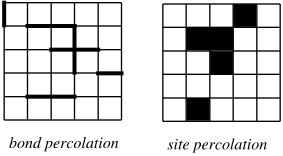
Bond percolation is a model in discrete percolation theory on a regular point lattice  in
in  -dimensional Euclidean space
that takes the lattice graph edges as the relevant
entities (left figure). The precise mathematical construction for the Bernoulli
percolation model version of bond percolation is given below.
-dimensional Euclidean space
that takes the lattice graph edges as the relevant
entities (left figure). The precise mathematical construction for the Bernoulli
percolation model version of bond percolation is given below.
First, define the set  of edges of
  to be the set
 |
(1)
|
and designate each edge of  to be independently "open" with probability
 ![p in [0,1]](/images/equations/BondPercolation/Inline6.svg) and closed with probability
and closed with probability  . Next, define an open path
to be any path in
. Next, define an open path
to be any path in  all of whose edges are open, and define the so-called open
cluster
all of whose edges are open, and define the so-called open
cluster  to be the connected component of the random
subgraph of
to be the connected component of the random
subgraph of  consisting of only open edges and containing the vertex
  . Write
  . The main objects of study in the bond percolation model
are then the percolation probability
. The main objects of study in the bond percolation model
are then the percolation probability
 |
(2)
|
and the critical probability
 |
(3)
|
where  is defined to be the product measure
 |
(4)
|
 is the Bernoulli measure which assigns
 whenever
  is closed and assigns
  when
when  is open, and
  is the percolation
threshold. Bond models for which
is the percolation
threshold. Bond models for which  will have infinite connected components (i.e., percolations)
whereas those for which
will have infinite connected components (i.e., percolations)
whereas those for which  will not.
For nearest-neighbor Bernoulli bond percolation on  , the critical-value question asks whether
 |
(5)
|
An AI-generated Lean 4 development released by Anthropic (2026) claims this equality for every integer  ,
including the previously unresolved dimensions 3 through 10. The formal theorem concerns
the value at
,
including the previously unresolved dimensions 3 through 10. The formal theorem concerns
the value at  ;
it does not directly state continuity of
;
it does not directly state continuity of  throughout
 ![[0,1]](/images/equations/BondPercolation/Inline26.svg) . The repository reports kernel checking and adversarial
AI review, but no independent human verification had been reported as of Sep. 9,
2026.
. The repository reports kernel checking and adversarial
AI review, but no independent human verification had been reported as of Sep. 9,
2026.
In general, bond percolation is considered less general than site percolation due to the fact that every bond model may be reformulated as a site model on a different lattice but not vice versa. Mixed percolation is considered to be a bridge between the two. Note, too, the existence of several other variants of bond percolation; for example, one could drop the assumption of independence to obtain a non-Bernoulli, dependent bond model.
