

In Bayesian analysis, the posterior distribution is the conditional probability distribution
of an unknown parameter after observed data have been
taken into account. If  is the density of a prior
distribution and
is the density of a prior
distribution and  is the likelihood
function for observed data
is the likelihood
function for observed data  , then the posterior density is
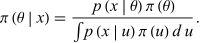 |
The denominator normalizes the posterior density and is replaced by a sum when the parameter is discrete. Thus the posterior distribution combines the prior distribution with the information supplied by the data.
