

The Pólya eigenvalue conjecture asserts that the Dirichlet and Neumann eigenvalues of the negative Laplacian
on a bounded domain  satisfy
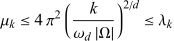 |
(1)
|
for  , where
 is the volume of the unit
ball,
 is the volume of the domain,
 are the eigenvalues for Neumann
boundary conditions, and
 are the eigenvalues
for Dirichlet boundary conditions,
counted with multiplicity (Dai and Sun 2026).
Dai and Sun (2026) proved the Neumann inequality for every circular annulus  with
 ,
 |
(2)
|
for all  . Their proof combines analytic estimates with
computer-assisted interval certificates covering the remaining parameter ranges.
Tang and Wang (2026a) reported the strict Dirichlet inequality
 |
(3)
|
for every nonempty bounded, simply connected planar domain  and every
 .
The authors supply an accompanying formalization.
Tang and Wang (2026b) separately reported the strict Neumann inequality
 |
(4)
|
for every nonempty bounded, simply connected planar domain  with Lipschitz
boundary and every
 .
The indexing begins with
 .
The general conjecture remains open.
Tang and Wang (2026ab) acknowledge ChatGPT assistance with technical arguments and Aristotle and Codex assistance with Lean formalizations. The registered Neumann development passed machine checks, but independent specialist review of the complete argument had not been reported as of Oct. 15, 2026.
For a round spherical shell  with
 , Li (2026a) proved the strict Dirichlet bound
 |
(5)
|
for every  and every
 . Here
 counts eigenvalues at most
 , with multiplicity,
and
 is the gamma function. Li (2026a) also proved the
corresponding strict inequality for the Aharonov-Bohm operator on planar annuli
at arbitrary magnetic flux. These are Dirichlet results and do not assert a Neumann
inequality.
Li (2026b) subsequently proved the strict Neumann inequality for the same spherical shells:
 |
(6)
|
for every  ,
 ,
and
 . Here
 counts eigenvalues strictly
below
 , with multiplicity,
including the zero Neumann eigenvalue. Li (2026b)
also proved the corresponding strict bound for balls.
