

The Poisson-Nernst-Planck system is a coupled system of partial differential equations for diffusion with a self-consistent potential. The repulsive
single-species system on  is
 |  |  |
(1)
|
 |  |  |
(2)
|
where  is a density,
 is its Newtonian potential, and
 is a prescribed confinement potential. The sign of the
self-interaction is repulsive. This formulation couples a diffusion equation with
Poisson's equation (Biler and Dolbeault 2000,
Li 2026).
For  or 3,
 ,
 , and mass
 ,
there is a unique equilibrium density
 with that mass, characterized by
 |  |  |
(3)
|
 |  |  |
(4)
|
For nonnegative initial data  of mass
 ,
assume
 and finite free energy
 |
(5)
|
where  is the Newtonian potential of
 .
Li (2026, Theorems 1.2 and 1.3) proved
 |
(6)
|
The corresponding spectral gap of the linearized problem in its adapted density-and-potential energy inner
product is exactly  ,
independently of
 .
Its eigenspace at
 consists of translation modes.
The center of mass follows the exact law  . More generally, for nonnegative initial
data of mass
 with finite first moment, if the
centered density
 satisfies the weighted square-integrability
condition, then
 |
(7)
|
with  (Li 2026, Theorem 1.4). Thus removing the translation mode gives faster convergence;
 is not asserted to equal
 in both dimensions. The weighted initial-data condition
is imposed after centering because that weighted space is not translation invariant.
For the unconfined two-dimensional system, the same analysis yields convergence to the expanding self-similar density  ,
with
 in the profile equation. The uncentered
 convergence rate is
 ; after centering, the corresponding rate is
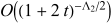 under the stated weighted initial-data conditions (Li 2026, Theorem 4.10).
