


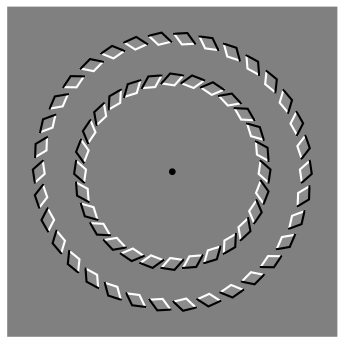
The Pinna-Brelstaff illusion is an apparent rotation produced by a static pattern of two concentric rings of small oriented elements. When an observer fixates the center and moves toward or away from the figure, the rings appear to rotate in opposite directions even though no element actually moves (Pinna and Brelstaff 2000).
In the standard figure, each ring is made from small rhombi whose light and dark edges are slanted in opposite directions. Radial image expansion or contraction is therefore locally ambiguous with tangential motion, and combining the local signals around a ring produces the apparent rotation. Reversing the local orientation reverses the perceived direction, while removing the slant greatly weakens the effect. The illusion can also be produced by animating the radial scale while the observer remains still (Gurnsey and Page 2006).
