

A perfect Gaussian integer is a Gaussian integer  satisfying
 |
(1)
|
where  is Spira's Gaussian divisor function, which is
a multiplicative function. In detail,
write the prime factorization
is Spira's Gaussian divisor function, which is
a multiplicative function. In detail,
write the prime factorization
 |
(2)
|
where  is a unit and the Gaussian
primes
is a unit and the Gaussian
primes  are chosen in the first quadrant of the complex
plane, with
are chosen in the first quadrant of the complex
plane, with ![Re[pi_j]>0](/images/equations/PerfectGaussianInteger/Inline5.svg) and
and ![Im[pi_j]>=0](/images/equations/PerfectGaussianInteger/Inline6.svg) .
Then
.
Then
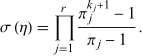 |
(3)
|
The unit  does not enter the product
(Spira 1961).
does not enter the product
(Spira 1961).
A different convention, used by Pegg (2003), chooses from each equivalence class of divisors under multiplication
by a unit the unique representative  with
with  and
and  . A Gaussian integer
is perfect in this sense when the sum of its selected proper divisors equals it. Sanchez Solovieva (2026)
found the example
. A Gaussian integer
is perfect in this sense when the sum of its selected proper divisors equals it. Sanchez Solovieva (2026)
found the example
 |
(4)
|
whose prime factorization can be written
 |
(5)
|
The sum of the 32 selected divisors is  ,
so
,
so  is perfect in this sense but not in Spira's.
A Gaussian integer is even when  divides it. It is norm-perfect
when
divides it. It is norm-perfect
when
 |
(6)
|
where  .
Every perfect Gaussian integer is norm-perfect, but the converse need not hold. For
example, the Gaussian prime
.
Every perfect Gaussian integer is norm-perfect, but the converse need not hold. For
example, the Gaussian prime  is odd and norm-perfect, but not perfect (Ward 2008). A
perfect or norm-perfect Gaussian integer is called primitive when it has no nonunit
perfect or norm-perfect proper divisor, respectively.
is odd and norm-perfect, but not perfect (Ward 2008). A
perfect or norm-perfect Gaussian integer is called primitive when it has no nonunit
perfect or norm-perfect proper divisor, respectively.
McDaniel (1974) proved a Gaussian analog of the characterization of even perfect numbers by Euclid and Euler. The primitive even perfect Gaussian integers are precisely
 |  |  |
(7)
|
 |  |  |
(8)
|
where  is a rational prime number satisfying
  and
and  is a Gaussian Mersenne
prime. The smallest known such exponent is
is a Gaussian Mersenne
prime. The smallest known such exponent is  .
In this case,
.
In this case,
 |  |  |
(9)
|
 |  |  |
(10)
|
 |  |  |
(11)
|
It is not known whether any odd perfect Gaussian integers exist. Ward (2008) proved that every odd norm-perfect Gaussian integer is of the form
 |
(12)
|
where  is an odd Gaussian prime,
  is odd, and
  and
and  are relatively prime.
