

Penney's game, also called Penney-Ante, is a game of coin tossing in which two players select different three-symbol strings
of heads H and tails T. The coin is tossed until one chosen string
first appears as three consecutive outcomes, and its player wins. The outcomes are
independent random variables, with
H and T each having probability  (Gardner 1974, p. 122).
If the first player chooses  , the second can choose
 , where the bar interchanges H and T. This
response wins with probability at least
 and at most
 . Thus there is no unbeatable
three-symbol string, and the relation
"more likely to appear first" is not transitive
(Gardner 1974, pp. 122-123).
More generally, consider two distinct strings  and
 of the same positive integer length
 ,
using the same fair model of coin tossing. For two
such strings
 and
 , let
 be 1 when the last
 symbols of
 equal the first
 symbols of
 , and 0 otherwise, and define
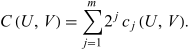 |
Writing  for the event that
 appears before
 , the probability
is
 |
The formula is due to Conway (Gardner 1974, pp. 123-124; Miller 2026).
