

The peaceable queens problem asks for the largest nonnegative integer  such that
 white queens and
 black queens can occupy distinct squares
of an
 chessboard without any queen attacking a queen of the
opposite color, where
 is a positive integer
(Ainley 1977, Numberphile 2019). Queens of the same color may attack one another,
unlike in the queens problem. Equivalently, no
row, column, or diagonal may contain both colors. Any such line
containing both colors would have consecutive occupied squares
of opposite colors, with no intervening queen to block the attack. For squares
indexed by
 ,
an opposite-color pair must have different values of each of
 ,
 ,
 , and
 (Yao and Zeilberger 2022).
For  ,
2, ..., 8, the values are 0, 0, 1, 2, 4, 5, 7, 9, ... (OEIS A250000).
An elementary upper bound is
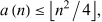 |
where  is the floor function. To see this, suppose the
white queens use
 rows and
 columns. Then
 , while the black queens are confined to the other
rows and columns, so
 . If
 , then
 . Otherwise,
 , giving the same bound from the black queens.
A stronger asymptotic upper bound is
 |
for all sufficiently large  (Clinch et al. 2025). This bound does not establish
that a known construction is optimal for every board size.
