

Pattern recognition is the assignment of observations to class labels or structured descriptions using measured features. In statistical pattern recognition, the feature vector is modeled as a random
variable  ,
and a classifier is a function that assigns an observed
value
,
and a classifier is a function that assigns an observed
value  to one of the classes
  , ...,
  .
.
A Bayes classifier is the classifier obtained from the Bayes decision rule. Given the posterior
probabilities  and a loss function
  , the Bayes classifier chooses
an action
, the Bayes classifier chooses
an action  that minimizes the conditional risk
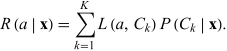 |
For a zero-one loss function, an incorrect label costs 1 and a correct label costs 0, so this reduces to choosing the most probable class,
 |
Pattern recognition includes classification, cluster analysis, feature extraction, and sequence labeling.
