The partition function of a system with states
It normalizes the weights into probabilities
In a continuous or field-theoretic system, the sum is replaced formally by a functional integral . In Euclidean quantum field
theory , for example,
where Euclidean action . This statistical-mechanical
partition function is distinct from the number-theoretic partition functions that
count integer partitions .
See also Euclidean Action ,
Euclidean Quantum Field Theory ,
Functional Integral ,
Partition ,
Partition
Function P ,
Random-Cluster Model
Explore with Wolfram|Alpha
References Baxter, R. J. Exactly Solved Models in Statistical Mechanics. Glimm,
J. and Jaffe, A. Quantum
Physics: A Functional Integral Point of View, 2nd ed.
Cite this as:
Weisstein, Eric W. "Partition Function."
From MathWorld https://mathworld.wolfram.com/PartitionFunction.html
Subject classifications


 , energies
  , and parameter
  is
is
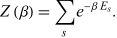
 and generates thermodynamic quantities
through derivatives of
and generates thermodynamic quantities
through derivatives of  .
.
![Z=inte^(-S_E[phi])Dphi,](/images/equations/PartitionFunction/NumberedEquation2.svg)
 is the Euclidean action. This statistical-mechanical
partition function is distinct from the number-theoretic partition functions that
count integer partitions.
is the Euclidean action. This statistical-mechanical
partition function is distinct from the number-theoretic partition functions that
count integer partitions.
