


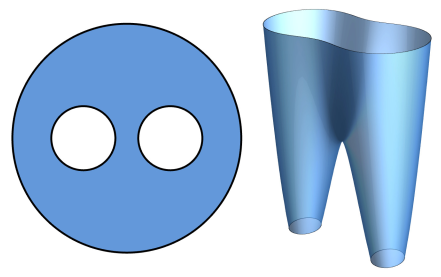
A pair of pants is a compact surface obtained from a sphere by removing the interiors of three pairwise disjoint closed disks. Equivalently, it is a closed disk with the interiors of two pairwise disjoint closed disks removed (Farb and Margalit 2012, p. 53). The two-dimensional figure at left shows this planar model, while the three-dimensional figure at right shows the same surface in its familiar pants shape, with one waist opening and two leg openings. In either model, a pair of pants is an orientable surface of genus 0 with three boundary components, and its Euler characteristic is
 |

The ZIP proof gives another construction. Two disjoint arcs on the outer boundary of an annulus form a zip-pair. Identifying them in opposite induced boundary directions preserves orientability and closes each of the two gaps into its own boundary circle. These are the gold and green circles in the figure. The blue inner boundary of the annulus stays intact, so the resulting surface has three boundary circles (Conway et al. 2008, p. 100, Fig. 8.6).
Pairs of pants are building blocks for compact orientable surfaces with negative Euler characteristic. A pants decomposition is obtained by cutting such a surface along pairwise disjoint simple closed curves so that every resulting component is a pair of pants (Buser 1992).
