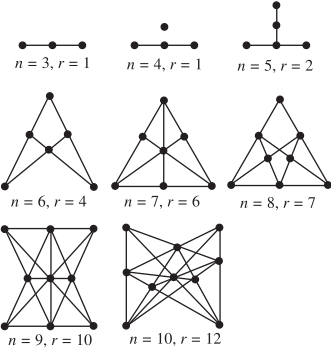
The orchard-planting problem (also known as the orchard problem or tree-planting problem) asks for the maximum number of straight lines containing
exactly
of
distinct points in the plane.
Equivalently, the points represent trees and the lines
represent rows, with positive integers. The problem for is attributed to Sylvester (Croft et al. 1991, p. 159).
Interval entries in the table give lower and upper bounds (Friedman).
Sylvester showed that
(1)
where
is the floor function (Ball and Coxeter 1987).
Burr et al. (1974) have shown using cubic curves
that
(2)
Known sporadic constructions for , 11, 16, and 19 have 6, 16, 37, and 52 three-point lines,
respectively, compared with 5, 15, 35, and 51 from the right-hand side of the preceding
bound (Pegg 2018). At least these four sporadic values are therefore known, while
the existence of any others remains open.
Green and Tao (2013) proved that the preceding bound is exact for all sufficiently large .
In other words, for all sufficiently large . For , the general upper bound is


 of straight lines containing
exactly
 of
 distinct points in the plane.
Equivalently, the points represent trees and the lines
represent rows, with positive integers
 . The problem for
 is attributed to Sylvester (Croft et al. 1991, p. 159).
 or bounds on them reported by Friedman.


 is the floor function (Ball and Coxeter 1987).
Burr et al. (1974) have shown using cubic curves
that

 , 11, 16, and 19 have 6, 16, 37, and 52 three-point lines,
respectively, compared with 5, 15, 35, and 51 from the right-hand side of the preceding
bound (Pegg 2018). At least these four sporadic values are therefore known, while
the existence of any others remains open.
 .
In other words,
 for all sufficiently large
 . For
 , the general upper bound is

 is the ceiling function.

 Pegg, E. Jr. "Cultivating
New Solutions for the Orchard-Planting Problem." Wolfram Blog, Feb. 2,
2018.