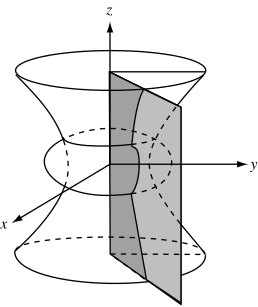
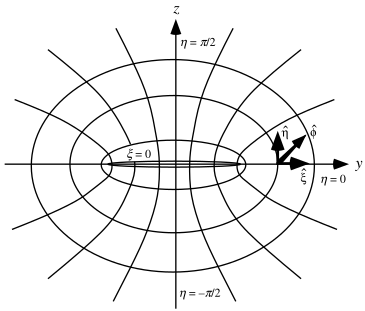
Oblate spheroidal coordinates are a system of curvilinear coordinates in which two sets of coordinate surfaces are obtained by revolving
the curves of the elliptic cylindrical
coordinates about the y -axisz -axis
where scale factors
are
The Laplacian is
where
An alternate form uses the coordinates
where Cartesian coordinates
are
with scale factors
Away from the coordinate singularities, the Laplacian
is
(18)
The Helmholtz differential equation
is separable.
See also Helmholtz Differential Equation--Oblate Spheroidal Coordinates ,
Latitude ,
Longitude ,
Prolate
Spheroidal Coordinates ,
Spherical Coordinates
Explore with Wolfram|Alpha
References Abramowitz, M. and Stegun, I. A. (Eds.). "Definition of Oblate Spheroidal Coordinates." §21.2 in Handbook
of Mathematical Functions with Formulas, Graphs, and Mathematical Tables, 9th printing. Arfken, G. "Prolate Spheroidal
Coordinates (Mathematical
Methods for Physicists, 2nd ed. Byerly, W. E. An
Elementary Treatise on Fourier's Series, and Spherical, Cylindrical, and Ellipsoidal
Harmonics, with Applications to Problems in Mathematical Physics. Moon, P. and Spencer, D. E. "Oblate
Spheroidal Coordinates Field
Theory Handbook, Including Coordinate Systems, Differential Equations, and Their
Solutions, 2nd ed. Morse,
P. M. and Feshbach, H. Methods
of Theoretical Physics, Part I. National
Institute of Standards and Technology. "Wave Equation in Oblate Spheroidal Coordinates."
§30.14 in NIST Digital Library of Mathematical Functions. https://dlmf.nist.gov/30.14 . Referenced
on Wolfram|Alpha Oblate Spheroidal Coordinates
Cite this as:
Weisstein, Eric W. "Oblate Spheroidal Coordinates."
From MathWorld https://mathworld.wolfram.com/OblateSpheroidalCoordinates.html
Subject classifications




 ,
 ,
 ,
and
 .
Arfken (1970) uses
 instead of
 . The scale factors
are


 .
These expressions apply away from the coordinate singularities, with
 and
 .


 ,
 ,
and
 .
The corresponding Cartesian coordinates
are



 ,
 ,
 )." §2.11 in
 ." Table 1.07 in