


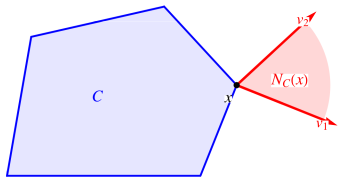
The normal cone to a closed convex set  at a point
  is
is
 |
In the illustration, the point  is a vertex of the convex
polygon
is a vertex of the convex
polygon  ,
and the red boundary rays of
,
and the red boundary rays of  are generated by outward normal
vectors
are generated by outward normal
vectors  and
and  to the two incident sides.
For nonzero  and
and  , the defining inequality says that
the angle between them is a right
angle or an obtuse angle. The normal cone is
a convex cone. By convention,
, the defining inequality says that
the angle between them is a right
angle or an obtuse angle. The normal cone is
a convex cone. By convention,  is the empty set when
  .
.
At a point in the interior of a full-dimensional  ,
the normal cone is
,
the normal cone is  .
At a smooth boundary point of a full-dimensional
.
At a smooth boundary point of a full-dimensional
 , it is the ray
generated by the outward normal vector. At a vertex of a convex polyhedron,
it is generated by the outward normal vectors of
the facets incident to the vertex.
Normal cones are fundamental in the optimality conditions of convex
optimization theory.
, it is the ray
generated by the outward normal vector. At a vertex of a convex polyhedron,
it is generated by the outward normal vectors of
the facets incident to the vertex.
Normal cones are fundamental in the optimality conditions of convex
optimization theory.
