

A nonaveraging sequence in the sense used here is a sequence of positive integers
 |
(1)
|
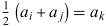
in which no three distinct terms form an arithmetic progression. Equivalently, there are no distinct  ,
,  ,
,  such that
 |
(2)
|
Sets with this property are also called Salem-Spencer sets, 3-AP-free sets, and progression-free sets (Salem and Spencer 1942, Dybizbański 2012). The empty set, one-element sets, and two-element sets are therefore trivially nonaveraging.
The terminology is not uniform. Wróblewski (1984) calls a set nonaveraging when no member is the arithmetic mean of two distinct other members, as above. Abbott (1980), however, calls a set nonaveraging when no member is the arithmetic mean of any two or more distinct other members. Abbott's condition is therefore stronger.
Consider all subsets of  . There is one nonaveraging sequence on
  (
( ), two on
  (
( and
and  ), four on
  , and so on. For example, 13 of the 16 subsets of
  are nonaveraging, with
  ,
,  , and
, and  excluded. The numbers of nonaveraging subsets on
  ,
,  , ... are 1, 2, 4, 7, 13, 23, 40, ... (OEIS A051013).
Let  be the largest cardinality of a nonaveraging subset
of
be the largest cardinality of a nonaveraging subset
of  .
The values of
.
The values of  for
for  ,
1, ... are 0, 1, 2, 2, 3, 4, 4, 4, 4, 5, ... (OEIS A003002).
Equivalently, the smallest values of
,
1, ... are 0, 1, 2, 2, 3, 4, 4, 4, 4, 5, ... (OEIS A003002).
Equivalently, the smallest values of  for which
  has a nonaveraging subset of cardinality
  , for
, for  , 2, ..., are 1, 2, 4, 5, 9, 11, 13, 14, 20, ... (OEIS A065825). If
  denotes the latter sequence, then
  exactly when
  .
.
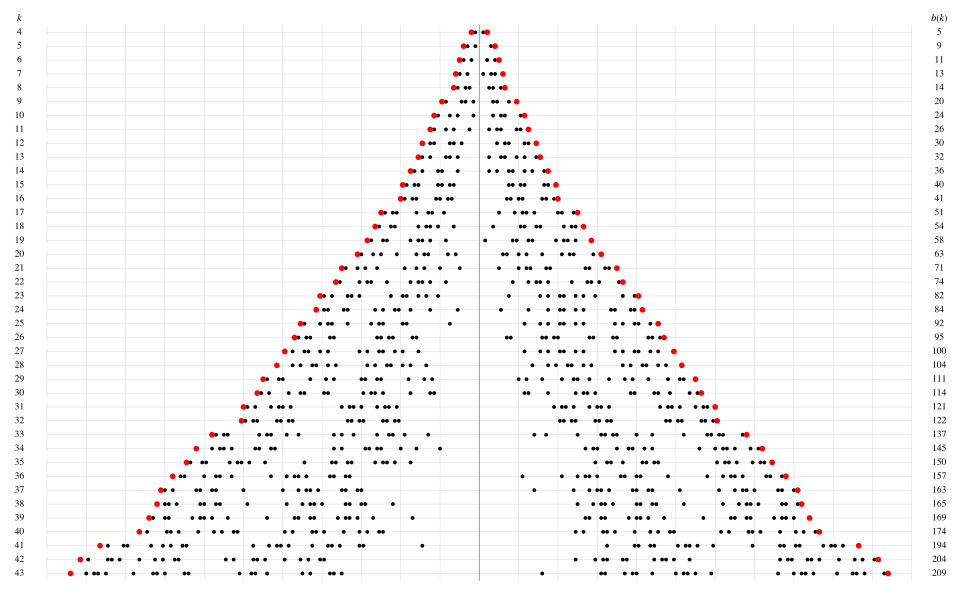
For each  ,
5, ..., 43, the illustration above shows one nonaveraging subset of
,
5, ..., 43, the illustration above shows one nonaveraging subset of  having cardinality
  . Each row is centered at the midpoint
of its smallest and largest elements, with the endpoints shown in red. The labels
at left give
. Each row is centered at the midpoint
of its smallest and largest elements, with the endpoints shown in red. The labels
at left give  ,
and those at right give
,
and those at right give  . These representatives need not be unique.
The study of  was initiated by Erdős and Turán (1936), who conjectured both that
  and that
  for some
  . Salem and Spencer (1942) disproved the latter conjecture
by showing that
. Salem and Spencer (1942) disproved the latter conjecture
by showing that  for sufficiently large
  . Behrend (1946) improved this lower
bound to
. Behrend (1946) improved this lower
bound to  .
In the opposite direction, Roth (1952, 1953) proved the upper
bound
.
In the opposite direction, Roth (1952, 1953) proved the upper
bound  ,
and therefore established the first conjecture. The
positive constants in these bounds need not be the same (Dybizbański 2012).
,
and therefore established the first conjecture. The
positive constants in these bounds need not be the same (Dybizbański 2012).
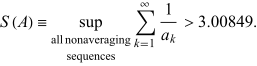
Wróblewski (1984) showed that for infinite nonaveraging sequences,
 |
(3)
|

 Terms." Proc. Amer. Math. Soc. 62, 211-214,
1977.Gerver, J. L. and Ramsey, L. "Sets of Integers with No
Long Arithmetic Progressions Generated by the Greedy Algorithm." Math. Comput. 33,
1353-1360, 1979.Guy, R. K. "Nonaveraging Sets. Nondividing
Sets." §C16 in
Terms." Proc. Amer. Math. Soc. 62, 211-214,
1977.Gerver, J. L. and Ramsey, L. "Sets of Integers with No
Long Arithmetic Progressions Generated by the Greedy Algorithm." Math. Comput. 33,
1353-1360, 1979.Guy, R. K. "Nonaveraging Sets. Nondividing
Sets." §C16 in