


The no-three-in-a-line problem asks how many lattice points with  , for positive
integer
, for positive
integer  ,
can be selected with no three collinear. For
,
can be selected with no three collinear. For  , it is possible to select
  such points. Here, collinearity
is with respect to any straight line in the plane,
not only horizontal or vertical lines. The numbers of distinct
solutions (not counting reflections and rotations)
for
such points. Here, collinearity
is with respect to any straight line in the plane,
not only horizontal or vertical lines. The numbers of distinct
solutions (not counting reflections and rotations)
for  ,
3, ..., are 1, 1, 4, 5, 11, 22, 57, 51, 156, ... (OEIS A000769).
For large
,
3, ..., are 1, 1, 4, 5, 11, 22, 57, 51, 156, ... (OEIS A000769).
For large  ,
the conjecture is that it is only possible to select
at most
,
the conjecture is that it is only possible to select
at most  lattice points with no three collinear,
where
lattice points with no three collinear,
where
 |  |  |
(1)
|
 |  |  |
(2)
|
(OEIS A093602; Guy, pers. comm., Oct. 22, 2004), correcting Guy and Kelly (1968) and Guy (1994, p. 242) who found  .
.
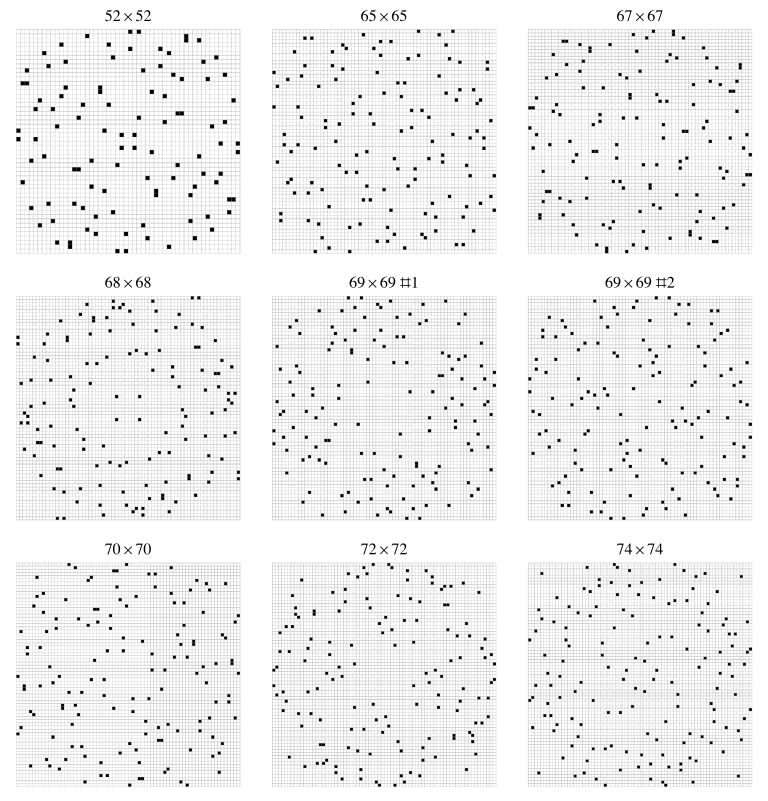
Selected configurations are illustrated above. Some large known no-three-in-a-line configurations are summarized in the following table. The entries are listed by Flammenkamp.
 | rotation class | discoverer |
| 52 | rot4 | Flammenkamp |
| 65 | rct4 | Heule (Jun. 18, 2026) |
| 67 | rct4 | Heule (Jun. 21, 2026) |
| 68 | rot4 | Prellberg (Mar. 23, 2026) |
| 69 | rct4 | Heule (Jun. 21, 2026) |
| 70 | rot4 | Heule (Jun. 17, 2026) |
| 71 | rct4 | Heule (Aug. 17, 2026) |
| 72 | rot4 | Heule (Jun. 25, 2026) |
| 73 | rct4 | Heule (Aug. 19, 2026) |
| 74 | rot4 | Prellberg (Jul. 20, 2026) |
| 76 | rot4 | Heule (Aug. 20, 2026) |
Here, rot4 denotes quarter-turn rotational symmetry and rct4 denotes quarter-turn symmetry except on the
long diagonals. (The full symmetry
is either half-turn rotational symmetry or
both diagonal reflections.) Heule's solutions were
found using a Boolean satisfiability (SAT)
solver. With Heule's  and 73 discoveries, configurations with
  points are now known for every
 point lattice with
  except
  . Heule's
  configuration is the largest currently known. Flammenkamp's
page illustrates the
configuration is the largest currently known. Flammenkamp's
page illustrates the  configuration and many additional configurations and counts.
Pegg (2026a) gives a Wolfram Language notebook for checking configurations by searching for extraordinary lines,
i.e., lines containing at least three selected points,
and reports Prellberg's enumeration of 118057 solutions for  .
.
A minimum variant asks for the smallest no-three-in-a-line subset of an  point lattice that is maximal, i.e., such that adding
one more counter on any vacant lattice point produces
three on a line. The corresponding numbers for
point lattice that is maximal, i.e., such that adding
one more counter on any vacant lattice point produces
three on a line. The corresponding numbers for  , 2, ... begin 1, 4, 4, 4, 6, 6, 8, 8, 8, 8, 10, 10, ...
(OEIS A277433; Aichholzer et al. 2023).
Aichholzer et al. (2023) study this problem as a general
position version of the geometric dominating set
problem. Pegg (2026b) gives additional examples and computations for this minimum
variant.
, 2, ... begin 1, 4, 4, 4, 6, 6, 8, 8, 8, 8, 10, 10, ...
(OEIS A277433; Aichholzer et al. 2023).
Aichholzer et al. (2023) study this problem as a general
position version of the geometric dominating set
problem. Pegg (2026b) gives additional examples and computations for this minimum
variant.

The three-dimensional no-three-in-a-line problem asks for the largest number  of points in the
  integer lattice
with no three collinear in ordinary Euclidean
space. The figure shows the three horizontal layers of a 16-point configuration
for
integer lattice
with no three collinear in ordinary Euclidean
space. The figure shows the three horizontal layers of a 16-point configuration
for  supplied by Kudriashov (2026). The recorded values for
  , 2, ... begin 1, 8, 16, 28, 40, 64, ... (OEIS A399138;
Kudriashov 2026). Larger constructions give lower bounds rather than known exact
values. In particular, Kudriashov (2026) gives
, 2, ... begin 1, 8, 16, 28, 40, 64, ... (OEIS A399138;
Kudriashov 2026). Larger constructions give lower bounds rather than known exact
values. In particular, Kudriashov (2026) gives  and
and  , improving the 93-point example illustrated by Pegg
(2026c). This sequence received an honorable mention
in the OEIS 400K celebration contest (OEIS Foundation Inc. 2026).
, improving the 93-point example illustrated by Pegg
(2026c). This sequence received an honorable mention
in the OEIS 400K celebration contest (OEIS Foundation Inc. 2026).
Each of the  lines parallel to a fixed coordinate axis contains at most
two selected points, giving
lines parallel to a fixed coordinate axis contains at most
two selected points, giving  . Pór and Wood (2007, pp. 482-485)
proved
. Pór and Wood (2007, pp. 482-485)
proved  ,
where
,
where  denotes asymptotic notation. Their construction
includes the
denotes asymptotic notation. Their construction
includes the  points
  with
with  for any prime
  .
The third coordinate is reduced modulo
.
The third coordinate is reduced modulo  , but the prohibition is on collinearity
in Euclidean space.
, but the prohibition is on collinearity
in Euclidean space.

 Pegg, E. Jr. "Progress in the No-Three-in-Line-Problem."
Wolfram Community. May 11, 2026a.
Pegg, E. Jr. "Progress in the No-Three-in-Line-Problem."
Wolfram Community. May 11, 2026a.