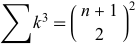
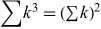
Nicomachus's theorem states that the sum of the first positive cubic numbers equals
the square of the sum of the first positive integers.
Nicomachus (1926, Ch. 20) noted that when the odd numbers are grouped in blocks of lengths 1, 2, 3, ..., i.e., 1; 3+5; 7+9+11;
13+15+17+19; ..., the th cubic number is a sum of consecutive odd numbers, for
example
When coupled with the early Pythagorean recognition that the sum of the first odd numbers is (Boyer and Merzbach 1991, p. 160), this leads to the
case of Faulhaber's formula
(6)
(7)
(8)
that is sometimes known as Nicomachus's theorem. For , 2, ..., the first few values are 1, 9, 36, 100, 225, 441,
784, 1296, 2025, ... (OEIS A000537), which
are squared triangular numbers and need not
themselves be triangular numbers. The values
1 and 36 are also square triangular numbers,
whereas 9 is not.
Benjamin, A. T. and Orrison, M. E. "Two Quick Combinatorial Proofs of ." College Math. J.33,
406-408, 2002.Benjamin, A. T.; Quinn, J. J.; and Wurtz, C.
"Summing Cubes by Counting Rectangles." College Math. J.37,
387-389, 2006.Boyer, C. B. and Merzbach, U. C. A
History of Mathematics, 2nd ed. New York: Wiley, pp. 159-160, 1991.Kanim,
K. "Proofs without Words: The Sum of Cubes--An Extension of Archimedes' Sum
of Squares." Math. Mag.77, 298-299, 2004.Nicomachus.
Ch. 20 in Introduction to Arithmetic (Trans. M. L. D'Ooge).
New York: Macmillan, 1926.Sloane, N. J. A. Sequence A000537
in "The On-Line Encyclopedia of Integer Sequences."Smith,
D. E. History
of Mathematics, Vol. 1: General Survey of the History of Elementary Mathematics.
New York: Dover, pp. 128-129, 1958.Stein, R. G. "A Combinatorial
Proof That ."
Math. Mag.44, 161-162, 1971.Stroeker, R. J. "On
the Sum of Consecutive Cubes Being a Perfect Square." Compos. Math.97,
295-307, 1995.


 positive cubic numbers equals
the square of the sum of the first
 positive integers.
 th cubic number
 is a sum of
 consecutive odd numbers, for
example





 , this set of identities follows from

 (Boyer and Merzbach 1991, p. 160), this leads to the
case of Faulhaber's formula


 , 2, ..., the first few values are 1, 9, 36, 100, 225, 441,
784, 1296, 2025, ... (OEIS A000537), which
are squared triangular numbers and need not
themselves be triangular numbers. The values
1 and 36 are also square triangular numbers,
whereas 9 is not.
 gives 3025.

 ." College Math. J. 33,
406-408, 2002.Benjamin, A. T.; Quinn, J. J.; and Wurtz, C.
"Summing Cubes by Counting Rectangles." College Math. J. 37,
387-389, 2006.Boyer, C. B. and Merzbach, U. C.
 ."
Math. Mag. 44, 161-162, 1971.Stroeker, R. J. "On
the Sum of Consecutive Cubes Being a Perfect Square." Compos. Math. 97,
295-307, 1995.