TOPICS
Search

Newton's Pi Series


NewtonsPiSeries

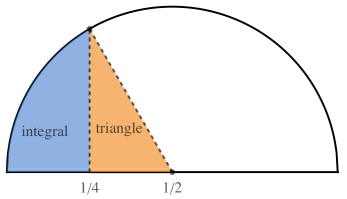
Newton's pi series is the rapidly convergent power series for pi that Newton obtained in 1666 by expanding the area of a circular segment. For a circle of unit diameter, the area under y=sqrt(x-x^2) from 0 to 1/4 combines with the adjacent triangle area to give

 pi=(3sqrt(3))/4+24int_0^(1/4)sqrt(x-x^2)dx.

Expanding the integrand using the binomial series and integrating term by term gives

 pi=(3sqrt(3))/4+24(1/(12)-1/(5·2^5)-1/(28·2^7)-1/(72·2^9)-...).

The choice of the small circular segment makes the powers decrease quickly, so the method was much faster than the polygonal approximations used previously (Borwein et al. 1989; Borwein and Bailey 2003, pp. 105-106; Veritasium 2021).


See also

Binomial Series, Circle, Pi Formulas, Power Series

Explore with Wolfram|Alpha

References

Borwein, J. and Bailey, D. Mathematics by Experiment: Plausible Reasoning in the 21st Century. Wellesley, MA: A K Peters, pp. 105-106, 2003.Borwein, J. M.; Borwein, P. B.; and Bailey, D. H. "Ramanujan, Modular Equations, and Approximations to Pi, or How to Compute One Billion Digits of Pi." Amer. Math. Monthly 96, 201-219, 1989.Veritasium. "The Discovery That Transformed Pi." Mar. 16, 2021. https://www.youtube.com/watch?v=gMlf1ELvRzc.Wells, D. The Penguin Dictionary of Curious and Interesting Numbers. Middlesex, England: Penguin Books, p. 50, 1986.

Cite this as:

Weisstein, Eric W. "Newton's Pi Series." From MathWorld--A Wolfram Resource. https://mathworld.wolfram.com/NewtonsPiSeries.html

Subject classifications