

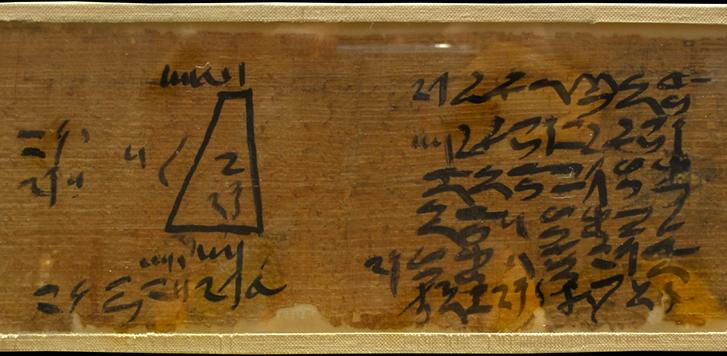
The Moscow Mathematical Papyrus is an ancient Egyptian mathematical text written in hieratic and dating to about 1850 BC. It contains 25 problems, seven of them concerning geometry, including problems on the areas of triangles and rectangles, the surface area of a hemisphere, and the volume of a pyramidal frustum (History of Mathematics Project).
It is called the Moscow Mathematical Papyrus for its present home at the Pushkin State Museum of Fine Arts in Moscow, where it is held as object E4676. It is also known as the Golenishchev Mathematical Papyrus after Vladimir Golenishchev, who bought it in Thebes in 1892 or 1893.
Problem 10 computes 32 as the surface area of a hemispherical basket whose mouth has
diameter  . Interpreted using the formula
  ,
this corresponds to the approximation
,
this corresponds to the approximation  . Problem 14 gives a truncated
square pyramid with top and bottom side lengths
. Problem 14 gives a truncated
square pyramid with top and bottom side lengths  and
and  and height
  . It correctly obtains
 |
and, on substituting the stated dimensions,
 |
