

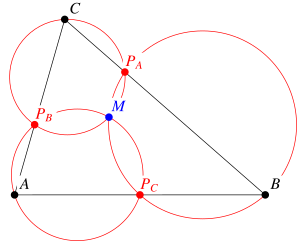
Miquel's theorem states that if points  ,
 , and
 are marked on the sides of a triangle
 , one on each side (or on a side's extension),
then the three Miquel circles (each through a polygon vertex and the two marked points on the adjacent
sides) are concurrent at a point
 called the Miquel point. This
result is a slight generalization of the so-called pivot
theorem.
If  lies in the interior of the triangle, then it satisfies
 |  |  |
(1)
|
 |  |  |
(2)
|
 |  |  |
(3)
|
The lines from the Miquel point to the marked points make equal angles with the respective sides. (This is a by-product of the Miquel equation.)
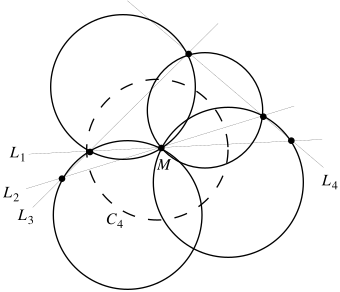
For four lines  , ...,
 in general position,
with no two parallel and no three concurrent,
the four circumcircles of the triangles
formed by triples of the lines meet at a point
 , called the 4-Miquel point. Their circumcenters
lie on a circle
 that also passes through
 (Johnson 1929, p. 139). The lines
from
 to the marked points on the sides make equal angles
with respect to the sides.
The orthogonal projections of  onto the four lines are collinear
(Johnson 1929, p. 139). Reflecting
 across the four lines therefore gives
four points on a line that is
the directrix of a parabola
with focus
 . This is the unique parabola tangent to all four lines (I. Larrosa
Cañestro, pers. comm., Sep. 11, 2008).
Clifford's circle theorem extends this incidence construction to configurations with alternating circles and common points.
