

Metric voting distortion is the worst-case loss in social cost incurred when a voting rule chooses a candidate from voters' ordinal rankings without knowing the distances that induce those rankings.
In the metric social choice theory model, a finite set  of voters and a finite set
  of candidates lie in a common metric space with metric
  . Each voter ranks the candidates by increasing distance.
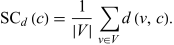
The social cost of a candidate
. Each voter ranks the candidates by increasing distance.
The social cost of a candidate  is the average
 |
(1)
|
A preference profile  records the rankings of all voters. If a deterministic
voting rule
records the rankings of all voters. If a deterministic
voting rule  assigns each profile to a candidate, its metric voting distortion is
 |
(2)
|
For a randomized voting rule,  is a probability distribution
on
is a probability distribution
on  ,
and the numerator is replaced by the expectation
value
,
and the numerator is replaced by the expectation
value  (Anshelevich et al. 2018).
The optimal distortion of a deterministic voting rule is 3. Anshelevich et al. (2018) established the lower bound using two-candidate examples, and Gkatzelis et al. (2020) gave a polynomial-time voting rule attaining it.
The randomized problem behaves differently. The conjecture that randomized rules could attain distortion 2 was disproved by Charikar and Ramakrishnan
(2022). Their lower bounds depend on the number  of candidates and tend to approximately 2.1126 as
  tends to infinity. The bound
is optimal for
tends to infinity. The bound
is optimal for  ,
but the optimal randomized distortion remains unknown for
,
but the optimal randomized distortion remains unknown for  .
.
On the upper bound side, Charikar et al. (2024) obtained a distortion less than 2.753 using a mixture involving a maximal lottery, the Nash equilibrium of an associated zero-sum game. Frank (2026) and Ye (2026) independently improved the bound to 2.5 by mixing a maximal lottery with Integrated Veto. Shah (2026) subsequently obtained
 |
(3)
|
This leaves a gap between the lower bound approaching 2.1126 and the upper bound 2.3282.
Shah's rule mixes Integrated Veto with a random-size stable lottery. For a positive-integer-valued random variable  , such a lottery guarantees that, for every candidate
  ,
the probability that a random voter prefers
,
the probability that a random voter prefers  to the voter's favorite of
  independent draws from it is at most the expectation
value of
independent draws from it is at most the expectation
value of  ,
where the probability also averages over
,
where the probability also averages over  . The proof combines infinite-dimensional conic linear
programming duality with exact rational verification of polynomial
nonnegativity in the Bernstein basis.
. The proof combines infinite-dimensional conic linear
programming duality with exact rational verification of polynomial
nonnegativity in the Bernstein basis.
Shah (2026) reports that GPT-5.6 Sol derived the mathematical proofs from research directions, literature connections, and proof strategies supplied by Shah. Shah checked all final mathematical details, generalized a model-proposed stable-lottery construction to random-size stable lotteries. Independent review of the 2.3282 bound has not yet been reported.
