

Metric space magnitude is a numerical invariant of a finite metric space  obtained from its similarity matrix
  , whose entries are
  . A weighting is a vector
  satisfying
  , where
  is the all-ones vector. If a weighting
exists, the magnitude is
is the all-ones vector. If a weighting
exists, the magnitude is  , a value independent of the choice of weighting.
When the similarity matrix is invertible, the weighting
is unique and
, a value independent of the choice of weighting.
When the similarity matrix is invertible, the weighting
is unique and
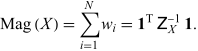 |
This invariant can be regarded as the effective number of points in the metric space at the scale set by its metric (Leinster 2013).
A metric space is positive definite if the similarity matrix of every nonempty finite subset
is a positive definite matrix. For a nonempty
compact subset  of such a space, magnitude can be defined as the supremum
of the magnitudes of its nonempty finite subsets (Meckes
2013).
of such a space, magnitude can be defined as the supremum
of the magnitudes of its nonempty finite subsets (Meckes
2013).
Magnitude is nowhere continuous with respect to the Gromov-Hausdorff distance on the space of finite metric spaces
for which it is defined (Katsumasa et al. 2025). By contrast, Liu (2026) reported
that magnitude is Hausdorff distance-continuous
at every nonempty finite subset  of a finite-dimensional positive-definite real normed
space
of a finite-dimensional positive-definite real normed
space  .
More precisely, suppose
.
More precisely, suppose  has
has  points,
  has dimension
  , and
, and  is the least eigenvalue
of
is the least eigenvalue
of  .
Let
.
Let  be the least distance between distinct points of
  when
when  , and let
  when
when  . If
. If  satisfies
 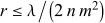 and
and  for a nonempty compact
subset
for a nonempty compact
subset  ,
then
,
then
 |
Up to linear isometry, the finite-dimensional positive-definite normed spaces are exactly the finite-dimensional
linear subspaces of  , the Lp-space
with
, the Lp-space
with  .
Liu (2026) credits GPT-6 Astra Pro and Claude Fable 5.1 with developing and refining
parts of the proof. Independent specialist review had not been reported as of Sep. 23,
2026.
.
Liu (2026) credits GPT-6 Astra Pro and Claude Fable 5.1 with developing and refining
parts of the proof. Independent specialist review had not been reported as of Sep. 23,
2026.

 Subspaces." Sep. 20, 2026.