

The mean square error (MSE) of predictions  for observed values
  is the arithmetic mean
of the squared errors
is the arithmetic mean
of the squared errors  ,
,
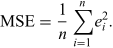 |
For an estimator  of a parameter
  , its mean square error is
![MSE(theta^^)=E[(theta^^-theta)^2]=Var(theta^^)+Bias(theta^^)^2,](/images/equations/MeanSquareError/NumberedEquation2.svg) |
where ![E[Y]](/images/equations/MeanSquareError/Inline6.svg) denotes the expectation value of
denotes the expectation value of  . Thus mean square error combines the variance
and squared estimator bias. Its square
root is the root-mean-square error,
which has the same units as the measured quantity.
. Thus mean square error combines the variance
and squared estimator bias. Its square
root is the root-mean-square error,
which has the same units as the measured quantity.
