A mean-payoff game is a two-player zero-sum game on a finite directed graph whose vertices
are assigned to the players Max and Min and whose edges
have numerical rewards. Each graph vertex has an
outgoing graph edge, and its owner chooses the next
graph edge. Both players observe the complete preceding
play and may choose strategies that depend on this history.
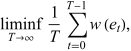
For the infinite walk traversing edges, the payoff to Max is
where
is the reward of graph edge and denotes the infimum limit.
Max seeks to maximize this payoff and Min seeks to minimize it. A positional strategy
chooses an outgoing graph edge using only the current
graph vertex.
Chatterjee, K.; Henzinger, M.; and Svozil, A. "Faster Algorithms for Mean-Payoff Parity Games." In Proc. 42nd International Symposium
on Mathematical Foundations of Computer Science (MFCS 2017) (Ed. K. G. Larsen,
H. L. Bodlaender, and J.-F. Raskin). Dagstuhl, Germany: Schloss Dagstuhl-Leibniz-Zentrum
für Informatik, pp. 39:1-39:14, 2017. https://doi.org/10.4230/LIPIcs.MFCS.2017.39.


 , the payoff to Max is
 is the reward of graph edge
 and
 denotes the infimum limit.
Max seeks to maximize this payoff and Min seeks to minimize it. A positional strategy
chooses an outgoing graph edge using only the current
graph vertex.
