

The Maxwell conjecture (Maxwell 1873) asserts that the potential function
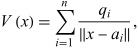 |
of  point charges at distinct points
  in three-dimensional Euclidean
space has at most
in three-dimensional Euclidean
space has at most  critical points, provided
they are all nondegenerate. The charge strengths
critical points, provided
they are all nondegenerate. The charge strengths  are nonzero real numbers,
and the locations
are nonzero real numbers,
and the locations  are excluded from the domain. Here nondegenerate means that the Hessian
at the critical point has a nonzero determinant.
are excluded from the domain. Here nondegenerate means that the Hessian
at the critical point has a nonzero determinant.
Arathoon et al. (2026) announced a counterexample with five positive charges and at least 24 nondegenerate critical points, exceeding the predicted bound 16. Their construction starts with three equal charges at the vertices of an equilateral triangle and adds two small charges on the perpendicular axis through its center. A small perturbation ensures that all critical points are nondegenerate.
The authors credit GPT-5.6 Sol with suggesting the construction and state that they verified the mathematical details and wrote the proof.
