

A Markov number  is a coordinate occurring in a positive integer
solution
 of the Markov equation
 |
(1)
|
and is related to Lagrange numbers  by
 |
(2)
|
The first few solutions are  , (1, 1, 2), (1,
2, 5), (1, 5, 13), (2, 5, 29), .... All solutions can be generated from the first
two of these since the equation is a quadratic
equation in each of the variables, so one integer
solution leads to a second, and it turns out that all solutions (other than the first
two singular ones) have distinct values of
 ,
 , and
 , and share two of their three
values with three other solutions (Guy 1994, p. 166). The Markov numbers are
given by 1, 2, 5, 13, 29, 34, ... (OEIS A002559).
The other coordinates in triples  with one coordinate fixed at 5 are 1, 2, 13, 29, 194,
433, ... (OEIS A030452), whose terms are given
by the recurrence relation
 |
(3)
|
for  , with
 ,
 ,
 , and
 .
The solutions can be arranged in an infinite tree with two smaller branches on each trunk. It is not known if two different regions can have the same label. Strangely, the regions adjacent to 1 have alternate Fibonacci numbers 1, 2, 5, 13, 34, ..., and the regions adjacent to 2 have alternate Pell numbers 1, 5, 29, 169, 985, ....
Let  count the positive integer solutions with
 . Then
 |
(4)
|
for every fixed  , where
 (Guy 1994, p. 166).
Risager (2026) sharpened the error term for this count of ordered triples to
 |
(5)
|
which in particular gives an error  . Here
 and
 denote big-O notation and
little-o notation. This counts solutions
with
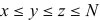 , rather than assuming the unproved
uniqueness of a triple from its largest coordinate.
