


The map number of a graph  is the least nonnegative integer
 for which
 is a
 -map graph. Such a representation consists of closed regions
on the sphere, each homeomorphic
to a closed disk, with disjoint interiors. Two regions are
adjacent exactly when their boundaries share a point, and
at most
 regions meet at any point. Write this quantity as
 , with
 when
 is not a map graph.
Equivalently, it is the minimum possible largest auxiliary vertex degree in a planar bipartite graph whose original
vertices are adjacent in  iff they share an auxiliary neighbor.
Each original vertex must have at least one such
neighbor (Chen et al. 1999, Theorem 2.2).
The null graph has map number 0, a nonempty empty graph has map number 1, and a planar graph with
an edge has map number 2. No graph
has map number 3. A  -free
graph is a map graph iff
it is a planar graph, where
 is the complete graph
on four vertices.
For a nonplanar graph with finite map number and clique number  ,
 ,
where
 is the ceiling
function (Chen et al. 1999, Theorem 2.7). Map number cannot increase on
taking an induced subgraph. For a nonempty disconnected graph, it is the maximum of the map
numbers of its connected components.
Special cases are given below. Here  ,
 ,
 ,
 , and
 denote the complete graph,
barbell graph, complete
bipartite graph, complete tripartite
graph, and hypercube graph, respectively.
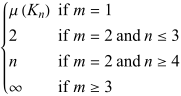
Write
 for the king
graph and
 for the rook graph on an
 board. Take
 for
 ,
 , and
 , and
 for
 . The remaining domains are
 for
 ,
 for
 , and
 for
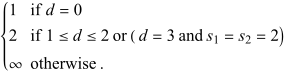
 . For a grid graph
 , discard dimensions of size one and sort the remaining sizes
as
 .
 |  | 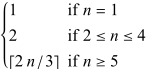 |
(1)
|
 |  |  |
(2)
|
 |  |  |
(3)
|
 |  | 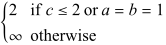 |
(4)
|
 |  | 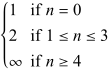 |
(5)
|
 |  | 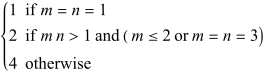 |
(6)
|
 |  |  |
(7)
|
 |  |  |
(8)
|
