

The Lovász local lemma is a probabilistic method for proving that a collection of events can all be avoided even when the events are not
mutually independent. Let  be events, and let
  be a dependency graph: each
  is independent of every event determined by the
  whose vertices are neither
  nor adjacent to
  in
in  . Write
  for the neighbors of
  . If there are numbers
  such that
 |
(1)
|
then
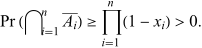 |
(2)
|
In particular, there is an outcome in which none of the events occurs.
The frequently used symmetric form assumes that  for every
  and that each event is dependent on at most
  other events. It is enough that
 |
(3)
|
Unlike a direct union bound, the local lemma exploits the limited dependence among the bad events. It has applications throughout combinatorics, including graph coloring, Ramsey theory, and constructions avoiding prescribed local configurations.
