A lobster graph, lobster tree, or simply "lobster," is a tree with a path graph
such that every graph vertex has graph
distance at most 2 from the path. Equivalently, deleting all pendant
vertices leaves the empty graph on 0 vertices
or a caterpillar graph (Koh et al. 1980,
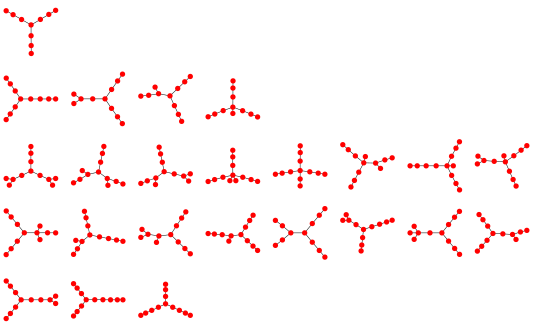
Chen et al. 1997, Gallian 2026). The numbers of lobsters on , 2, ... are 1, 1, 1, 2, 3, 6, 11, 23, 47, 105, 231,
532, 1224, 2872, ... (OEIS A130131), and the
corresponding numbers of nonlobsters are 0, 0, 0, 0, 0, 0, 0, 0, 0, 1, 4, 19, 77,
287, ... (OEIS A130132; the first few of which
are illustrated above). Precomputed properties of a number of lobster trees
are implemented in the Wolfram Language
as GraphData["Lobster"].

Lobster Graph
See also
Banana Tree, Caterpillar Graph, Lobster Polyiamond, TreeExplore with Wolfram|Alpha
References
Chen, W.-C.; Lu, H.-I.; and Yeh, Y.-N. "Operations of Interlaced Trees and Graceful Trees." Southeast Asian Bull. Math. 21, 337-348, 1997.Gallian, J. A. "A Dynamic Survey of Graph Labeling." Elec. J. Combin., Dynamic Survey DS6, Nov. 6, 2026. https://doi.org/10.37236/27.Koh, K. M.; Rogers, D. G.; Teo, H. K.; and Yap, K. Y. "Graceful Graphs: Some Further Results and Problems." Congr. Numer. 29, 559-571, 1980.Sloane, N. J. A. Sequences A130131 and A130132 in "The On-Line Encyclopedia of Integer Sequences."Referenced on Wolfram|Alpha
Lobster GraphCite this as:
Weisstein, Eric W. "Lobster Graph." From MathWorld--A Wolfram Resource. https://mathworld.wolfram.com/LobsterGraph.html