

The list packing number  of a finite simple
graph
 is the least positive integer
 such that every assignment of a
 -element color list
 to each graph vertex admits
 proper list colorings
 with
 whenever
 (Cambie et al. 2024). Thus the colorings collectively
use each available color exactly once at each graph vertex.
The correspondence packing number
 imposes the analogous requirement on every
 -fold correspondence
coloring cover. It requires a partition of the cover into
 independent vertex sets,
each meeting every color list exactly once. In particular,
 , where
 is the choice number.
Cambie et al. (2026) proved
 |
where  is the arboricity. The bound is sharp for arboricity
1 and 2. It gives a bound of 4 for every triangle-free planar
graph, and 8 for every
 -minor-free graph. For graphs
with maximum average degree less than
 , the correspondence packing number is at most 4,
and this density condition is sharp.
For a triangle-free planar graph with lists of four colors, the four disjoint colorings give a statistical
distribution on proper list colorings in which
every available color at every graph vertex is used
with probability  . Consequently, arbitrary preferred colors can be
satisfied simultaneously at at least a quarter of the requested vertices,
including the corresponding weighted version (Cambie et al. 2026). The authors
report that an AI suggestion to use a decomposition into two forests
initiated the proof approach.
Zhang (2026) proves a bound in terms of the maximum number  of forbidden partners of a single color in a correspondence
coloring cover of a finite bipartite
graph. For each integer
 , every such cover with
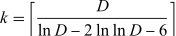 |
colors at each graph vertex admits a partition into  independent transversals, hence a full correspondence packing. Thus
 suffices, without bounding the degree of the
underlying bipartite graph. Another sufficient
condition for lists of size
 is that every color have at most
 forbidden partners. Zhang (2026) attributes the
displayed explicit choice of
 , following his asymptotic proof,
to a suggestion by GPT-6.1 Sol.
