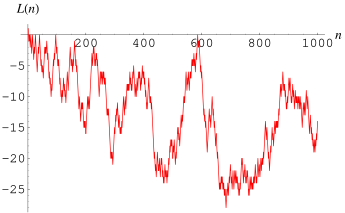
The refuted Pólya conjecture asserted that
for all .
In this range, the first positive value occurs at
(Tanaka 1980). The first zeros are 2, 4, 6, 10, 16, 26, 40, 96, 586, 906150256, 906150294,
906150308, 906150310, 906150314, 906151516, ... (OEIS A028488).
The function changes sign infinitely often (Borwein et al. 2008).
The values of for , 1, 2, ... are 1, 0, , , , , , , , ... (OEIS A090410).
Borwein, P.; Ferguson, R.; and Mossinghoff, M. J. "Sign Changes in Sums of the Liouville Function." Math. Comput.77,
1681-1694, 2008. https://doi.org/10.1090/S0025-5718-08-02036-X.Fawaz,
A. Y. "The Explicit Formula for ." Proc. London Math. Soc.1, 86-103,
1951.Gupta, H. "On a Table of Values of ." Proc. Indian Acad. Sci. Sec. A12,
407-409, 1940.Gupta, H. "A Table of Values of Liouville's Function
."
Res. Bull. East Panjab University, No. 3, 45-55, 1950.Lehman,
R. S. "On Liouville's Function." Math. Comput.14, 311-320,
1960.Ramanujan, S. "Irregular Numbers." J. Indian Math.
Soc.5, 105-106, 1913.Ramanujan, S. Collected
Papers of Srinivasa Ramanujan (Ed. G. H. Hardy, P. V. S. Aiyar,
and B. M. Wilson). Providence, RI: Amer. Math. Soc., pp. 20-21, 2000.Ribenboim,
P. Algebraic
Numbers. New York: Wiley, p. 44, 1972.Roberts, J. The
Lure of the Integers. Washington, DC: Math. Assoc. Amer., p. 279, 1992.Sloane,
N. J. A. Sequences A002819/M0042,
A028488, and A090410
in "The On-Line Encyclopedia of Integer Sequences."Tanaka,
M. "A Numerical Investigation on Cumulative Sum of the Liouville Function."
Tokyo J. Math.3, 187-189, 1980.


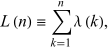
 is a positive integer and
  is the Liouville
function. For real numbers
is the Liouville
function. For real numbers  , define
  , with
  , where
  is the floor function.
Its first values for
is the floor function.
Its first values for  , 2, ... are 1, 0,
  , 0,
, 0,  , 0,
, 0,  ,
,  ,
,  , 0,
, 0,  ,
,  ,
,  ,
,  ,
,  , 0,
, 0,  ,
,  ,
,  ,
,  , ... (OEIS A002819).
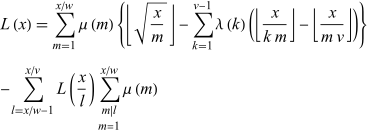

 ,
,
 ,
and
,
and  range over the positive integers,
  is the Möbius function,
 is the Mertens function, and
  ,
,  , and
, and  are positive real
numbers with
are positive real
numbers with  . The second formula holds for any positive
integer
. The second formula holds for any positive
integer  .
.
 for all
  .
In this range, the first positive value occurs at
.
In this range, the first positive value occurs at  (Tanaka 1980). The first zeros are 2, 4, 6, 10, 16, 26, 40, 96, 586, 906150256, 906150294,
906150308, 906150310, 906150314, 906151516, ... (OEIS A028488).
The function
(Tanaka 1980). The first zeros are 2, 4, 6, 10, 16, 26, 40, 96, 586, 906150256, 906150294,
906150308, 906150310, 906150314, 906151516, ... (OEIS A028488).
The function  changes sign infinitely often (Borwein et al. 2008).
 for
for  , 1, 2, ... are 1, 0,
  ,
,  ,
,  ,
,  ,
,  ,
,  ,
,  , ... (OEIS A090410).

 ." Proc. London Math. Soc. 1, 86-103,
1951.Gupta, H. "On a Table of Values of
." Proc. London Math. Soc. 1, 86-103,
1951.Gupta, H. "On a Table of Values of  ." Proc. Indian Acad. Sci. Sec. A 12,
407-409, 1940.Gupta, H. "A Table of Values of Liouville's Function
." Proc. Indian Acad. Sci. Sec. A 12,
407-409, 1940.Gupta, H. "A Table of Values of Liouville's Function
 ."
Res. Bull. East Panjab University, No. 3, 45-55, 1950.Lehman,
R. S. "On Liouville's Function." Math. Comput. 14, 311-320,
1960.Ramanujan, S. "Irregular Numbers." J. Indian Math.
Soc. 5, 105-106, 1913.Ramanujan, S.
."
Res. Bull. East Panjab University, No. 3, 45-55, 1950.Lehman,
R. S. "On Liouville's Function." Math. Comput. 14, 311-320,
1960.Ramanujan, S. "Irregular Numbers." J. Indian Math.
Soc. 5, 105-106, 1913.Ramanujan, S.