

The limit laws give the limit of an algebraic combination of functions in terms of their individual limits.
Let  and
 as
 on a common domain, where
 is an accumulation
point of that domain and
 and
 are finite. Then the sum, difference,
product, and constant multiple satisfy
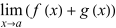 |  |  |
(1)
|
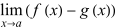 |  |  |
(2)
|
 |  |  |
(3)
|
 |  |  |
(4)
|
where  is a constant.
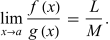
If
 , then
 for
 sufficiently close to
 on the punctured domain, and
 |
(5)
|
The quotient rule with a finite nonzero denominator limit does not cover an indeterminate form
such as  (Hunter 2014, p. 120).
