


Exponential least squares fitting with a positive amplitude  uses the model
 |
(1)
|
For data with  and
 not all identical, taking the logarithm
of both sides gives
 |
(2)
|
Minimizing the sum of squared residuals in the logarithms gives
 |  |  |
(3)
|
 |  |  |
(4)
|
where  and
 .
In general, this does not minimize the sum of squared errors in  . An alternative is to minimize the weighted sum
 |
(5)
|
Applying least squares fitting gives
 |
(6)
|
 |
(7)
|
 |
(8)
|
Solving for  and
 ,
 |  |  |
(9)
|
 |  |  |
(10)
|
where again  and
 . In particular,
 is the logarithm of the
exponential amplitude.
For small relative residuals,  approximates
 . Thus the weights
 approximately weight the squared residuals in
 by
 . Using weights
 instead approximates equal weighting of the squared residuals in
 .
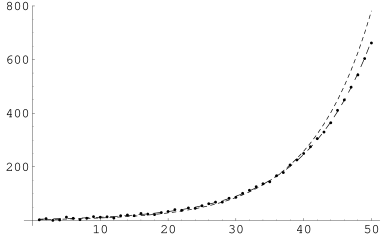
In the plot above, the short-dashed curve is the fit computed from (3) and (4) and the long-dashed curve is the fit computed from (9) and (10).
