

Korselt's criterion states that, for an integer  ,
,
 |
For composite  , the left-hand condition is equivalent to
  being a Carmichael number,
so these solutions are precisely the Carmichael
numbers (Korselt 1899).
being a Carmichael number,
so these solutions are precisely the Carmichael
numbers (Korselt 1899).
To prove sufficiency, consider each prime divisor  of
of 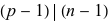 . If
. If  , then
  . Otherwise, Fermat's
little theorem and
. Otherwise, Fermat's
little theorem and  give
give  , so again
  . The squarefree condition
then combines these divisibilities to give
. The squarefree condition
then combines these divisibilities to give  .
.
Conversely, suppose  for every integer
  . If
. If  , the Chinese remainder
theorem gives an
, the Chinese remainder
theorem gives an  that is congruent to
  modulo
  and to 0 modulo the largest divisor
of
and to 0 modulo the largest divisor
of  relatively prime to
  . Then
  , contradicting
  , so
, so  is squarefree. For a prime divisor
  of
of  , use the Chinese remainder
theorem to choose
, use the Chinese remainder
theorem to choose  congruent to a primitive
root modulo
congruent to a primitive
root modulo  and to 1 modulo
  .
The number
.
The number  is relatively prime to
  , and
, and  . Since
  has multiplicative order
  modulo
  , it follows that
  .
.
